
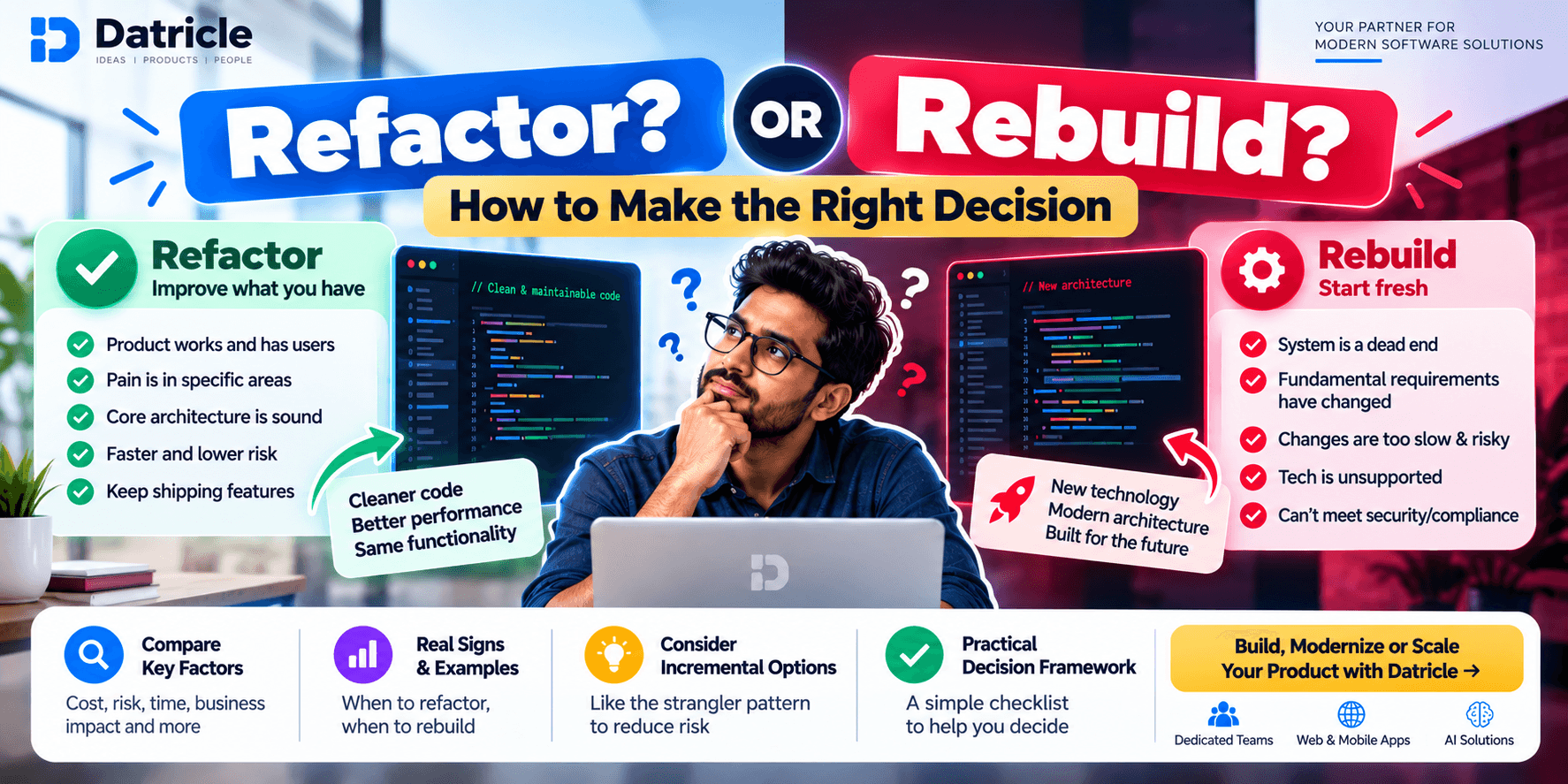
When to Rebuild vs Refactor Your Software
A decision framework for founders and product leaders facing aging software that is starting to slow them down.
Datricle • 7 Oct 2026
The short answer: refactor by default, rebuild only when the cost of continuing to change the current system reliably exceeds the cost and risk of replacing it. Most teams reach for a rebuild too early, drawn by the appeal of a clean slate, and underestimate how much hard-won business logic lives in the old code. A full rewrite is one of the riskiest moves a software team can make. This framework helps you tell the difference between a system that's genuinely at end of life and one that just needs disciplined, incremental improvement.
What these words actually mean
The terms get used loosely, so it's worth being precise before deciding.
- Refactoring is improving the internal structure of existing code without changing what it does from the outside. Users see no difference; the code becomes easier to work with.
- Re-architecting is a bigger, still-incremental change: swapping a database, breaking a monolith into services, or replacing a framework, usually one piece at a time while the system keeps running.
- Rebuilding (a rewrite) is starting a new codebase to replace the old one, then cutting over. It's the highest-risk option because you're re-creating years of accumulated behavior — including the edge cases nobody remembers.
Confusing these leads to bad decisions. Many problems people blame on "the whole thing being broken" are really a handful of painful modules that could be re-architected in place.
Signs you should refactor, not rebuild
Refactoring is the right call far more often than it feels like in the moment. Favor it when:
- The product works and has users. A system delivering value is worth preserving. Improve it under load rather than taking it offline in spirit for months.
- The pain is concentrated. If two or three modules cause most of the trouble, you can fix those without touching everything else.
- The core architecture is sound. Messy code on a reasonable foundation is a cleanup job, not a demolition.
- Your team understands the system. Knowledge of why things work the way they do is an asset a rewrite throws away.
- You can't afford a feature freeze. Rewrites usually slow new features to a trickle while the new system catches up to the old one.
Signs a rebuild may genuinely be warranted
Sometimes the honest answer is that the current system can't take you where you need to go. Consider a rebuild — ideally incremental — when several of these are true at once:
- Change has become prohibitively slow and risky. Every small feature takes weeks and breaks something unrelated, and this is consistent rather than occasional.
- The technology is a dead end. The framework or platform is unsupported, can't be hired for, or blocks capabilities the business now requires.
- Fundamental assumptions have changed. The system was built for a single tenant and you now need multi-tenancy; it was built for one country and you now operate globally. These are architectural, not cosmetic.
- Security or compliance can't be met in place. If the existing design can't satisfy requirements you're now legally bound to, patching has limits.
- No one can safely change it. The original team is gone and the code has no tests or documentation, so every change is a gamble.
Even then, a complete stop-the-world rewrite is rarely the best shape. The lower-risk path is usually to replace the system piece by piece.
The option most teams overlook: incremental replacement
You don't have to choose between "live with it" and "rewrite everything." The strangler pattern lets you build the new system around the old one, routing specific features to new code while the rest keeps running on the old. Over time the new system grows and the old one shrinks until it can be retired.
The advantages are substantial:
- The product keeps working and shipping the whole time.
- You get value from new parts immediately instead of waiting for a big-bang launch.
- Risk is spread across many small cutovers instead of concentrated in one.
- You can stop or adjust course if priorities change.
For most "our software is holding us back" situations, incremental replacement is the mature answer.
A simple decision checklist
Before committing either way, answer these honestly:
- What specific business outcome does changing the software unlock? If you can't name it, don't touch the architecture yet.
- Is the pain spread across the whole system, or concentrated in a few places you could isolate?
- Can we ship the thing we need on the current foundation with focused effort, even if it's unpleasant?
- What happens to new features during a rebuild, and can the business tolerate that pause?
- Do we understand the old system well enough to re-create its behavior, including the undocumented rules?
If the honest answers point to concentrated pain, a workable foundation, and a business that can't pause, refactor or re-architect. If they point to a dead-end platform, changed fundamentals, and change that's become genuinely unsafe, plan an incremental replacement — and reserve a full rewrite for the rare case where nothing else fits.
How Datricle can help
The hardest part of this decision is seeing your own system clearly — separating the few places that genuinely need replacing from the parts that just need care. At Datricle, we build and modernize web and mobile apps and SaaS products, and we provide dedicated development teams that work as an extension of your team. That means we can assess an existing codebase with you, recommend refactor-versus-rebuild honestly, and carry out the work incrementally so your product keeps running and shipping throughout.
If your software is slowing you down, resist the clean-slate instinct for a moment and map exactly where the pain lives. More often than not, the fix is smaller and far less risky than a full rebuild.
Work with Datricle
Planning a product or need engineering capacity?
Datricle builds AI-powered software, SaaS platforms and web & mobile apps — and provides dedicated development teams that plug into your roadmap. Book a free consultation and get clear guidance, timelines and a plan.
Explore: our services, case studies and dedicated development teams.