
Reduce Dev Costs Without Cutting Corners
Where software budgets actually leak, and how to spend less while keeping quality high.
Datricle • 14 Oct 2026
Short answer: The biggest software costs are rarely developer salaries. They are rework, unclear scope, idle coordination, and building things nobody uses. You cut real cost not by hiring the cheapest people or skipping testing, but by shrinking scope to what matters, reusing proven tools, keeping the team small and aligned, and preventing the expensive mistakes before they happen. Done well, lower cost and higher quality are the same thing.
Here is where budgets actually leak, and how to spend less without the shortcuts that cost more later.
Understand where the money really goes
When a software project runs over budget, people instinctively look at hourly rates. But most waste hides elsewhere:
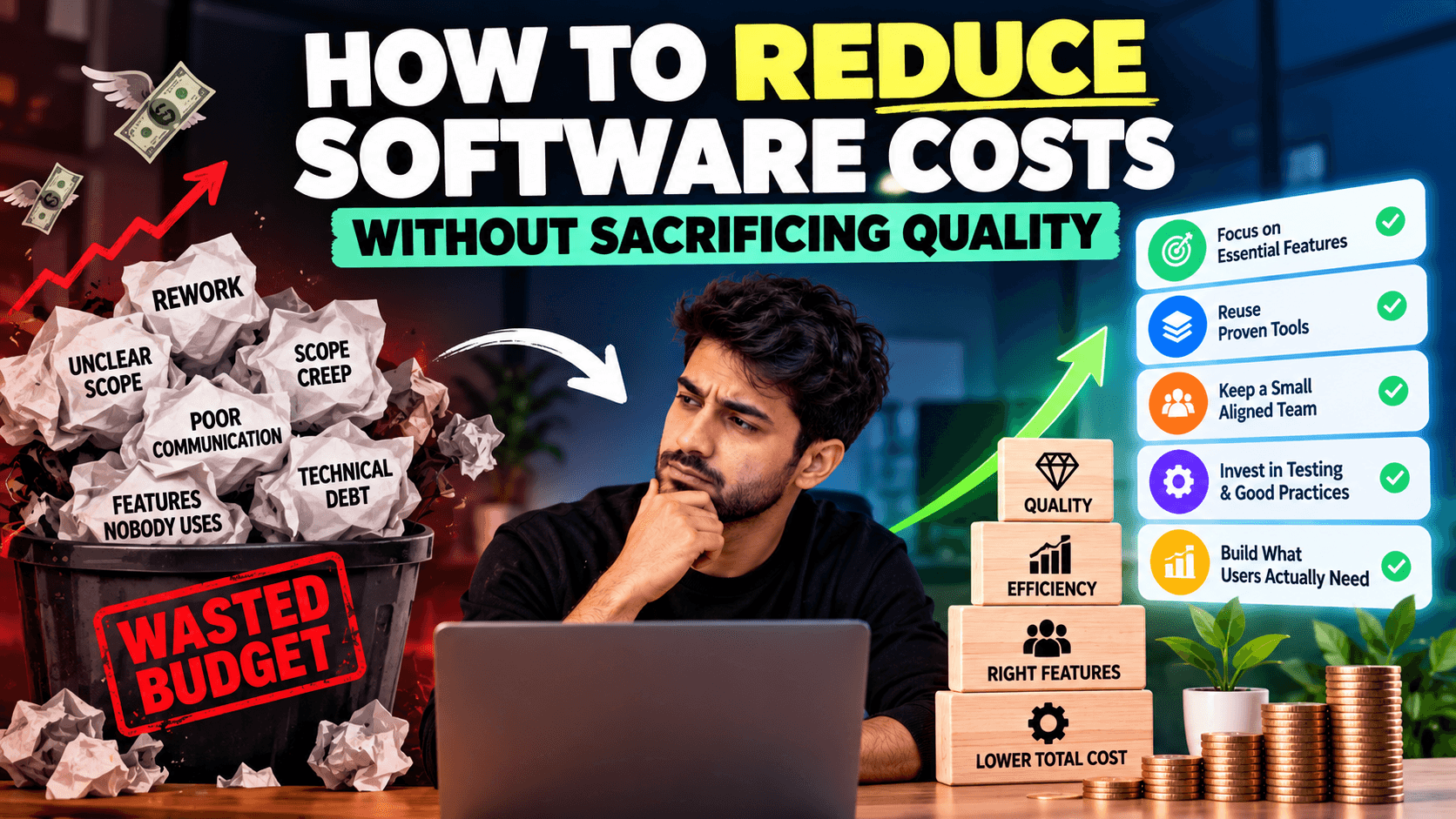
- Rework. Building the wrong thing, then rebuilding it. This is usually the single largest avoidable cost.
- Unclear requirements. Ambiguity turns into guesswork, and guesswork turns into throwaway work.
- Scope creep. Features added without discipline, each extending timelines and testing.
- Coordination overhead. Oversized teams and poor communication mean more meetings and more handoffs than actual building.
- Technical debt. Shortcuts that slow every future change until someone pays to undo them.
Notice that almost none of these are fixed by paying people less per hour. They are fixed by working smarter. That is the whole game.
Shrink the scope before you shrink the budget
The cheapest feature is the one you don't build. Every screen, setting, and edge case carries design, development, testing, and ongoing maintenance cost. The most effective cost control is ruthless prioritisation.
For each proposed feature, ask whether the product genuinely fails without it in this release. Anything that isn't a clear yes gets deferred. This is not about shipping less value; it is about shipping the right value first and letting real usage tell you what to build next, instead of paying to build features on a hunch.
Reuse instead of rebuild
A surprising amount of custom software recreates things that already exist as reliable, battle-tested tools. You rarely need to build your own authentication, payment handling, email delivery, or UI component system from scratch.
- Use established frameworks rather than bespoke foundations.
- Adopt hosted services for auth, payments, and infrastructure where they fit.
- Lean on component libraries for a clean interface without pixel-by-pixel custom design.
Every building block you adopt is code you don't write, test, or maintain. The savings compound over the life of the product, not just during the initial build.
Keep the team small and aligned
Adding people to a late project often makes it later. Communication cost grows faster than team size, and a large group working from a fuzzy brief produces conflicting work that has to be reconciled.
A small, senior, well-coordinated team usually delivers more per dollar than a big one. What makes a team efficient is not headcount but clarity: everyone knows the goal, decisions are made quickly, and work doesn't sit waiting on handoffs. This is also why a dedicated team that already works well together can be more cost-effective than assembling a group of the cheapest available individuals.
Invest in the things that prevent expensive mistakes
It is tempting to cut discovery, testing, and project management to save money. These are usually the worst places to economise, because they are precisely what prevents the costliest problems.
- Discovery and clear requirements cost a little up front and save a lot of rework.
- Automated testing catches regressions cheaply instead of letting bugs reach users, where they cost far more to fix.
- Code review and sensible standards keep the codebase maintainable, so future changes stay fast and cheap.
- Light but real project management keeps work aligned to goals and stops scope drift.
Skipping these feels like saving money. In practice it defers cost to a more expensive moment, usually with interest.
Beware false economies
Several popular ways to "save money" reliably cost more:
- Hiring purely on lowest rate. Cheap and inexperienced often means slow and error-prone, and you pay twice.
- Skipping tests to ship faster. Bugs in production are the most expensive bugs there are.
- Cutting architecture corners. A foundation that can't scale means a rebuild just when you're succeeding.
- Chronic underspecification. Vague briefs feel flexible but generate endless clarification and rework.
The common thread: these trade a visible short-term saving for a larger hidden future cost. Real efficiency avoids that trap.
Measure value, not just activity
Cost efficiency isn't only about spending less; it's about spending on what matters. Track whether features are actually used, whether they move the metrics you care about, and where time is going. A feature nobody uses was expensive no matter how cheaply it was built. Shipping in small increments and watching real usage lets you redirect spend toward what works instead of funding guesses.
How Datricle helps keep builds lean
At Datricle, we build and scale software for startups and enterprises as a dedicated team that works as an extension of yours, and cost efficiency is built into how we work. We start by sharpening scope so you build the right thing first, lean on proven frameworks and services instead of reinventing them, and keep teams small, senior, and aligned to avoid coordination waste. We treat discovery, testing, and maintainable code as cost-savers, not overhead, because they prevent the rework that quietly inflates most budgets. The result is lower total cost and software you won't have to rebuild.
The takeaway: don't chase the lowest price, chase the lowest waste. Narrow your scope, reuse what already works, keep the team tight, and invest in the practices that stop expensive mistakes. That is how you spend less and still ship something you're proud of.
Work with Datricle
Planning a product or need engineering capacity?
Datricle builds AI-powered software, SaaS platforms and web & mobile apps — and provides dedicated development teams that plug into your roadmap. Book a free consultation and get clear guidance, timelines and a plan.
Explore: our services, case studies and dedicated development teams.