
MVP vs Prototype vs POC: What's the Difference?
Three terms founders use interchangeably—and how choosing the right one saves you time and money.
Datricle • 3 Oct 2026
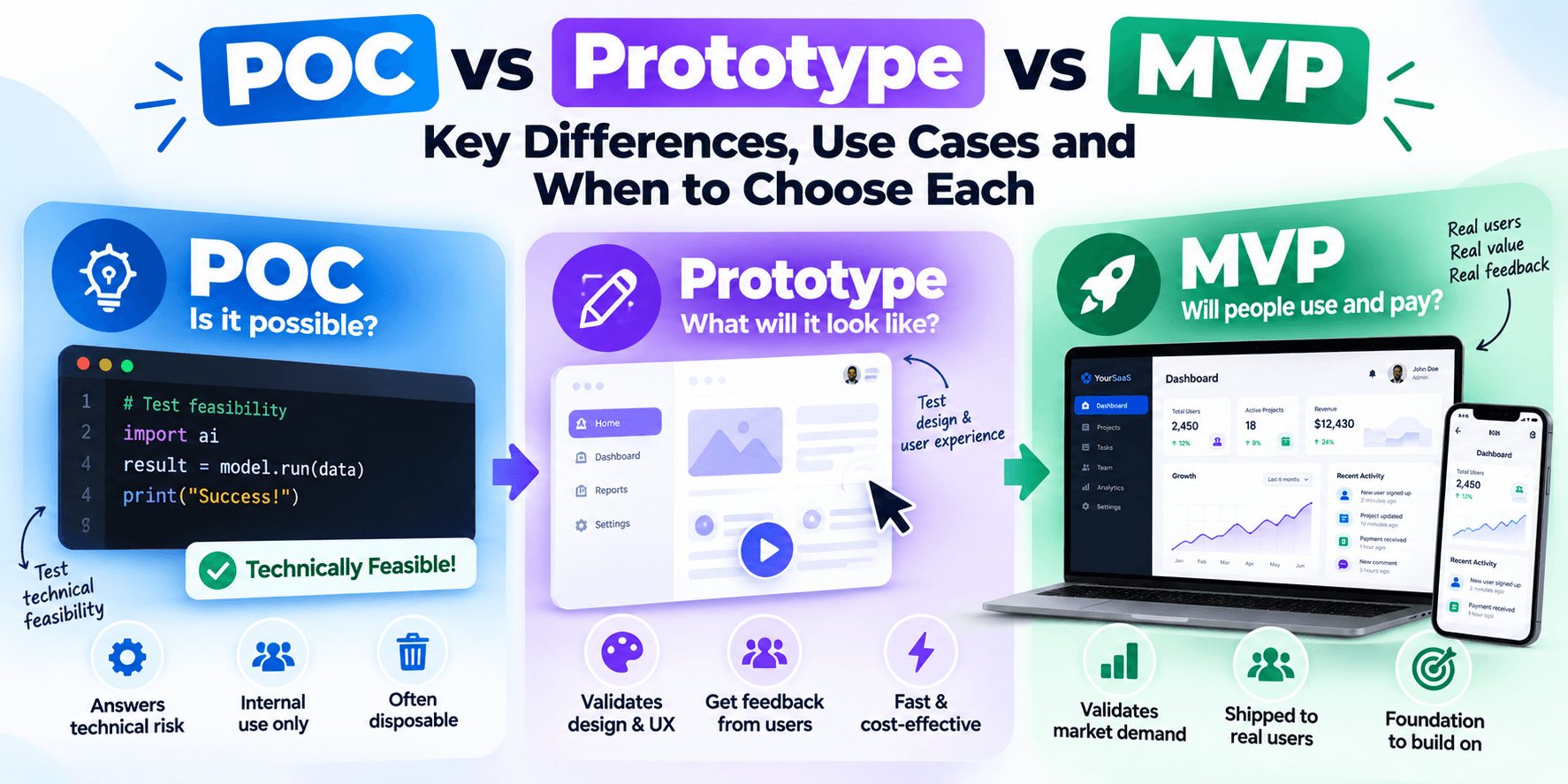
The short answer: a proof of concept (POC) answers "is this technically possible?", a prototype answers "what will it look and feel like?", and a minimum viable product (MVP) answers "will people actually use and pay for this?" They are not stages you must always pass through in order—they're different tools for different questions. Picking the right one for the question you actually have is one of the easiest ways to avoid wasting time and budget early in a product's life.
These three terms get used interchangeably in pitch decks and kickoff meetings, and the confusion is expensive. Teams build a polished MVP when a cheap POC would have exposed a fatal technical risk; others ship a throwaway prototype to real customers and draw the wrong conclusions. Knowing what each one is for keeps your early spending aligned with what you're actually trying to learn.
Proof of concept: can it be done?
A POC exists to reduce technical risk. It's a small, often rough experiment that answers a specific feasibility question before you commit real resources: Can we process this volume of data fast enough? Will this integration actually work? Can the model reach the accuracy we need?
Key characteristics of a POC:
- Narrow and internal. It's usually seen only by your team, not customers. Polish is irrelevant.
- Focused on one question. It tests the single riskiest assumption, not the whole product.
- Disposable. The code is often thrown away once you have your answer.
You need a POC when your product depends on something unproven—a hard technical challenge, a new technology, or an integration you're not sure is possible. If feasibility isn't in doubt, you can usually skip it.
Prototype: what will it feel like?
A prototype exists to explore and validate design and user experience. It's a model of how the product looks and flows, used to test ideas with stakeholders and users before engineering effort goes in. Prototypes range from clickable mockups that simulate the interface to interactive demos with no real backend behind them.
Key characteristics of a prototype:
- Focused on experience, not function. It looks real but the logic underneath is often faked or absent.
- Great for feedback. You can put it in front of users and investors to gather reactions cheaply.
- Fast and relatively inexpensive. Especially with modern design tools, a prototype can come together quickly.
You need a prototype when you want to validate the flow and feel of a product, align a team around a shared vision, or get feedback on the experience before building it for real. It answers design questions—not whether the business works.
MVP: will people use and pay for it?
An MVP is a real, working product—just limited to its most essential features. Crucially, it's released to actual users. Its purpose is to validate the business and market: do real people find this valuable enough to use, and ideally pay for? Unlike a prototype, an MVP genuinely functions. Unlike a POC, it's built to be used and extended, not thrown away.
Key characteristics of an MVP:
- Minimum and viable. It does the core job well and leaves everything non-essential out—but it's complete enough to deliver real value.
- Shipped to real users. Its entire point is to learn from genuine usage in the market.
- A foundation to build on. A well-built MVP is the first version of the real product, not a demo.
You build an MVP when you're confident the product is feasible and the experience is right, and now you need to prove that a market actually wants it. It's how you start learning from real customers with the least investment.
How they fit together
These tools map neatly onto the three big risks a new product faces:
- POC → technical risk: "Can we build it?"
- Prototype → design risk: "Will the experience work for users?"
- MVP → market risk: "Will people use and pay for it?"
You don't always need all three. A product using well-understood technology may skip the POC entirely. A simple, familiar interface may not need an elaborate prototype. The discipline is to ask which risk is most uncertain and most dangerous for your product, and reach for the tool that addresses it—rather than defaulting to building the full thing and hoping.
Common mistakes to avoid
- Treating a prototype as an MVP. A prototype's logic is often fake. Shipping it to paying customers and expecting it to perform is a recipe for broken trust.
- Turning a POC into production code. POCs are built fast and rough to answer one question. Growing one into your real product carries all that shortcut debt forward.
- Over-building the MVP. "Minimum" is doing real work here. Every feature you add before validation is a bet placed before you have evidence.
- Skipping the question. The worst mistake is building something without being clear on which risk you're trying to retire. Name the question first; the right tool follows.
How Datricle can help
At Datricle, we help startups and enterprises choose the right first step and build it properly—whether that's a quick POC to de-risk a hard technical bet, a prototype to validate the experience, or an MVP engineered as a real foundation you can scale. Because we provide dedicated developers who work as an extension of your team, we focus on retiring your biggest risk first and building only what the current question requires, so you spend your early budget learning rather than guessing. If you're unsure which of these you actually need, that's usually the most valuable conversation to have before any code is written.
Work with Datricle
Planning a product or need engineering capacity?
Datricle builds AI-powered software, SaaS platforms and web & mobile apps — and provides dedicated development teams that plug into your roadmap. Book a free consultation and get clear guidance, timelines and a plan.
Explore: our services, case studies and dedicated development teams.