
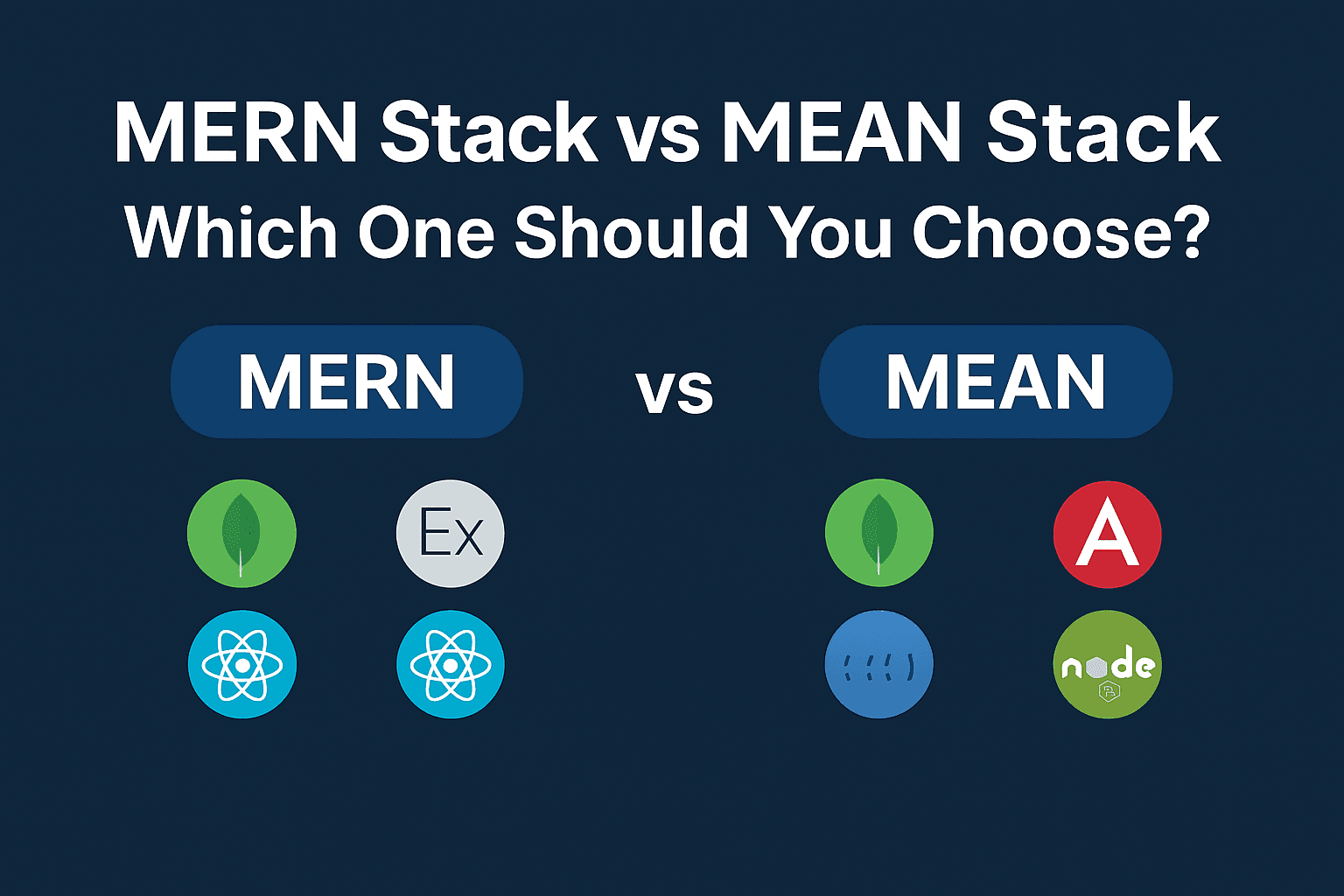
MERN Stack vs MEAN Stack: Which One Should You Choose?
A Complete Comparison of MERN & MEAN for Modern Web Development
Admin • 24 Nov 2025
MERN Stack vs MEAN Stack: Which One Should You Choose?
When it comes to full-stack development, JavaScript-based stacks have become the industry standard because they offer speed, flexibility, and end-to-end development using a single programming language. Among the most popular choices, the MERN stack and MEAN stack stand out as two powerful frameworks used for building scalable and dynamic web applications.
Both are widely used by startups, enterprise businesses, and SaaS companies—but the question remains: Which stack should you choose for your next project?
This article breaks down the differences between MERN and MEAN, helping you make an informed decision based on performance, ease of use, scalability, and real-world applications.
What Is the MERN Stack?
MERN stands for:
- MongoDB – NoSQL database
- Express.js – backend framework
- React.js – frontend library
- Node.js – JavaScript runtime
MERN is highly popular because React offers great performance, reusable UI components, and a rich ecosystem for building interactive single-page applications (SPAs).
Key Benefits of MERN
✔ React ensures fast rendering using Virtual DOM
✔ Easy component-based architecture
✔ Large React community and ecosystem
✔ Best for modern, dynamic UI-heavy applications
✔ Great performance for high-traffic platforms
What Is the MEAN Stack?
MEAN stands for:
- MongoDB
- Express.js
- Angular
- Node.js
Unlike MERN, MEAN uses Angular, a TypeScript-based framework maintained by Google. Angular is more structured and ideal for large enterprise-level applications.
Key Benefits of MEAN
✔ Clean architecture with strong TypeScript support
✔ Ideal for large-scale enterprise apps
✔ Built-in features such as routing, form validation, and testing
✔ Follows MVC architecture
✔ Highly secure and efficient
MERN vs MEAN: A Detailed Comparison
Architecture & Structure
MERN (React):
- Component-based
- More flexible and customizable
- Ideal for highly interactive UI
MEAN (Angular):
- Structured and opinionated
- Best for enterprise-grade applications
- Built-in features reduce dependency on third-party libraries
Winner: Depends on project style—MERN for flexibility, MEAN for structure.
Learning Curve
MERN:
React is simpler to understand than Angular. Developers love its JSX and component-driven architecture.
MEAN:
Angular is more complex due to TypeScript, decorators, modules, and dependency injection.
Winner: MERN is easier for beginners.
Performance
MERN:
React’s Virtual DOM gives extremely high performance, especially for dynamic UI updates.
MEAN:
Angular is powerful but heavier; two-way data binding can sometimes reduce speed in complex UIs.
Winner: MERN (faster performance for UI-heavy apps).
Scalability
Both MERN and MEAN are scalable because they use Node.js and MongoDB.
However, Angular (MEAN) offers better structure for large enterprise systems due to its strong architecture.
Winner: MEAN (better for large-scale enterprise systems).
Security
MEAN:
Angular offers better built-in security features, such as DOM sanitization and routing guards.
MERN:
Still secure but often needs external security packages.
Winner: MEAN
Development Speed
MERN:
React + third-party packages allow faster development and flexibility.
MEAN:
Angular includes ready-made tools but requires more initial setup.
Winner: MERN
Best Use Cases for MERN Stack
Choose MERN if your project involves:
- Social media platforms
- Real-time dashboards
- SaaS products
- E-commerce stores
- Content sharing platforms
- Single-page applications (SPA)
- Portfolio & startup applications
Best Use Cases for MEAN Stack
Choose MEAN if your project is:
- Enterprise-level project management systems
- ERP or CRM applications
- Banking & finance dashboards
- Large data-driven platforms
- Government or organizational portals
- Secure multi-user web apps
Which One Should You Choose?
The decision depends on your project goals:
✔ Choose MERN if you want:
- Fast front-end performance
- Highly interactive UI
- Quick development
- Flexible customization
- Startup or mid-size project
✔ Choose MEAN if you want:
- A structured, enterprise-grade architecture
- Large projects with complex logic
- Built-in security and scalability
- A long-term development framework
- TypeScript-based development
Conclusion
Both MERN and MEAN are powerful tech stacks that dominate modern web development.
- MERN is perfect for developers who want speed, modern UI, and flexibility.
- MEAN is ideal for enterprise organizations needing structure, scalability, and long-term stability.
Your choice should depend on the project requirements, team skills, and long-term goals. With the rise of digital transformation in 2025, businesses and developers must select the stack that aligns best with their growth strategy.
Work with Datricle
Planning a product or need engineering capacity?
Datricle builds AI-powered software, SaaS platforms and web & mobile apps — and provides dedicated development teams that plug into your roadmap. Book a free consultation and get clear guidance, timelines and a plan.
Explore: our services, case studies and dedicated development teams.