
Keep an Offshore Dev Team Aligned Across Time Zones
How high-functioning distributed teams turn a time-zone gap into an advantage instead of a daily source of friction.
Datricle • 6 Oct 2026
You keep an offshore development team aligned across time zones by shifting from real-time coordination to deliberate, written, asynchronous communication — and by protecting a small daily window of overlap for the few things that genuinely need a live conversation. Alignment problems are rarely about the hours themselves; they are about unclear priorities, decisions that stall waiting for a reply, and context that lives in one person's head. Fix those, and a ten- or twelve-hour gap becomes a manageable rhythm instead of a daily source of friction.
Here is how high-functioning distributed teams actually make it work.
Treat the time gap as a feature, not just a problem
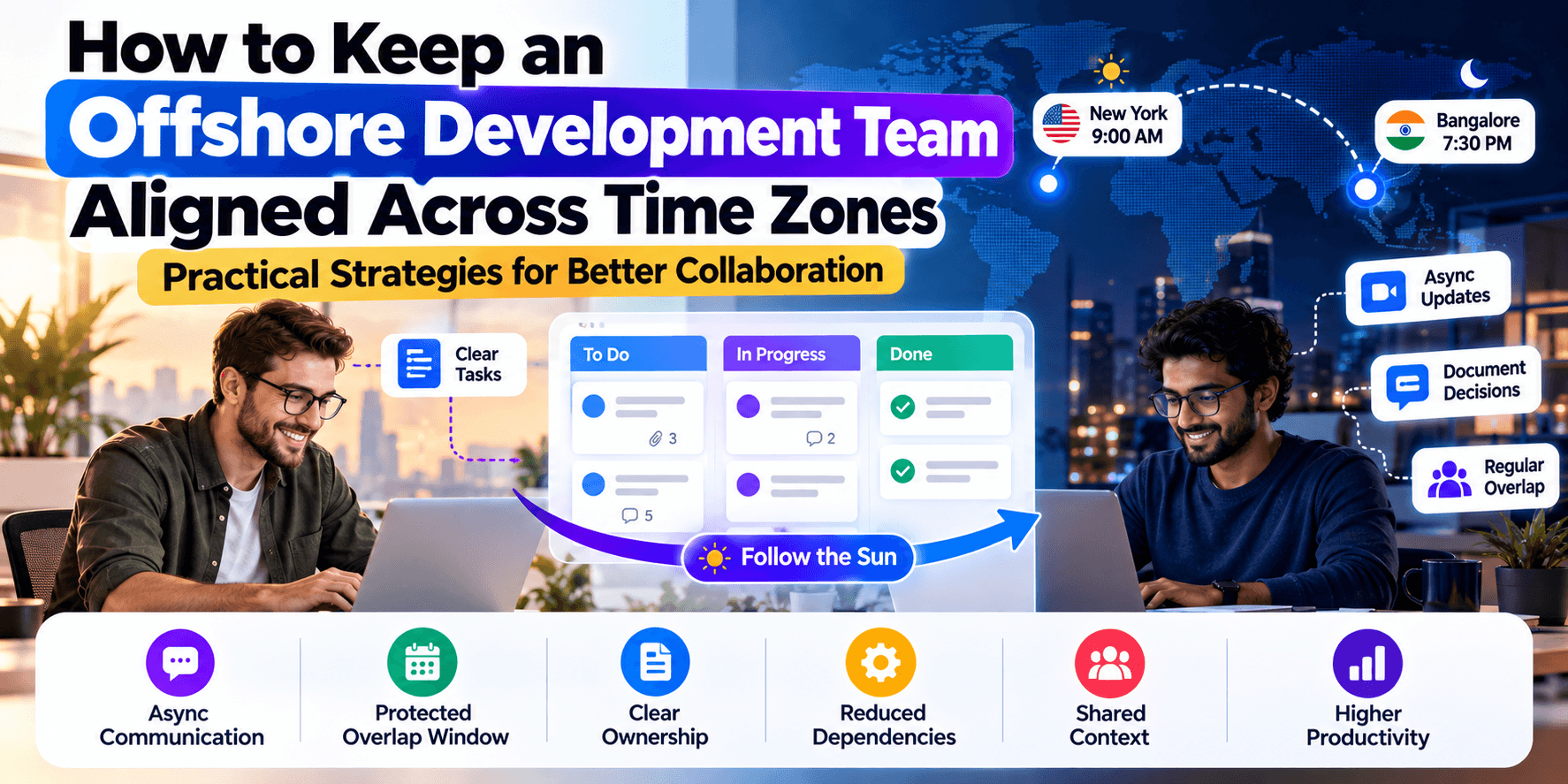
A large time difference has a real upside: when one side sleeps, the other works. A well-run distributed team can effectively "follow the sun," handing work off at the end of one day so it progresses while the other team rests. The teams that struggle are the ones trying to run an offshore team as if everyone were in the same office. The teams that thrive redesign their workflow around the gap.
The mindset shift is this: assume a reply might take until tomorrow, and build a process where that is fine. If a developer is blocked and has to wait twelve hours for an answer, you lose a full day. If they have enough written context to keep moving, you lose nothing.
Protect your overlap window — and spend it wisely
Almost every distributed setup has at least a one-to-three-hour window where both sides are awake. This overlap is your most valuable shared resource, so treat it deliberately.
- Reserve it for high-bandwidth conversations — decisions, design discussions, unblocking, and anything ambiguous enough that back-and-forth text would be slow.
- Do not waste it on status updates that could be written down and read later.
- Rotate the inconvenience fairly. If the overlap forces an early morning or late evening for someone, share that burden across the team over time rather than always imposing it on the offshore side.
- Keep a lightweight standup within the window, or replace it with a written one if even that is hard to schedule.
Make asynchronous the default
Async communication is the backbone of distributed work. The goal is that anyone can pick up a task, understand it fully, and make progress without needing a live person to explain it.
In practice that means:
- Write decisions down where everyone can find them. A decision made verbally in an overlap call is lost unless it is recorded. Keep a durable, searchable record of what was decided and why.
- Over-communicate context in writing. A good task ticket includes the goal, the reasoning, acceptance criteria, relevant links, and known edge cases — enough that someone twelve hours away can act on it without a follow-up question.
- Use recorded video for anything visual. A two-minute screen recording explaining a bug or a design often replaces a meeting entirely and can be watched on the other side's schedule.
- Set response-time expectations. Agree on what "urgent" means and how fast each type of message should be answered, so nobody waits on something that was never going to be answered quickly.
Reduce blocking dependencies
The real cost of a time-zone gap shows up when one person cannot proceed without another. Minimize those chokepoints.
Give the offshore team genuine ownership of complete, self-contained pieces of work rather than small fragments that constantly depend on someone else. Break work into independent units so parallel progress is possible. Keep a visible, well-groomed backlog of ready-to-start tasks, so that if someone finishes early or gets blocked, there is always clear, approved work to pick up instead of idle waiting.
Empower people to make reasonable decisions on their own. A team that must escalate every small choice across a time-zone gap will always be slow. Define clearly what decisions individuals can make independently and which ones truly require sign-off.
Build shared context and trust
Alignment is not only logistical — it is human. A team that understands the product vision and trusts each other needs far less supervision. Make sure the offshore team hears directly about the "why": the business goals, the users, and how their work fits the bigger picture. People who understand intent make better independent decisions.
Invest in relationships too. Occasional non-work conversation, clear and respectful written communication, and visible appreciation for good work all reduce the sense of distance. Where budget allows, periodic in-person time — or at least live face-to-face video — pays back heavily in smoother collaboration afterward.
Standardize tools and rituals
Consistency removes friction. A distributed team should share a single source of truth for tasks and status, a clear place for documentation, agreed channels for different kinds of communication, and a predictable cadence of ceremonies — planning, review, and retrospective — scheduled within the overlap window. When everyone knows where information lives and when things happen, the time gap stops creating uncertainty.
Common pitfalls to avoid
- Running the offshore team as "just hands." Teams given only narrow tasks and no context produce exactly what they were told and nothing more. Share ownership and intent.
- Relying on memory instead of writing. If it is not written down, it does not exist for the person who was asleep when it was said.
- Scheduling meetings that always punish the same side. Resentment quietly erodes alignment. Share the inconvenience.
- Measuring hours instead of outcomes. Distributed work is judged by delivered results, not by who was online when.
How Datricle can help
At Datricle, we provide dedicated development teams that work as a genuine extension of your own — and distributed collaboration is at the core of how we operate. We structure engagements around clear ownership, strong written communication, protected overlap windows, and transparent tooling, so that working across time zones becomes an advantage rather than an obstacle. Our teams are set up to take real responsibility for outcomes, keep you informed without constant oversight, and keep work moving while you sleep. If you are building or scaling with an offshore or distributed team, we can help you put the structure in place to keep everyone aligned and productive.
Work with Datricle
Planning a product or need engineering capacity?
Datricle builds AI-powered software, SaaS platforms and web & mobile apps — and provides dedicated development teams that plug into your roadmap. Book a free consultation and get clear guidance, timelines and a plan.
Explore: our services, case studies and dedicated development teams.