
How to Vet a Dev Team's Code Quality Before Hiring
What to ask for and what to look for so you don't inherit a codebase you regret.
Datricle • 13 Oct 2026
The short answer: you don't need to read code to judge code quality. You judge it by asking for a small paid trial, reviewing a real sample with a neutral senior engineer, and watching how the team communicates, tests, documents, and handles mistakes. Good teams make their quality visible on purpose; teams that dodge these requests are telling you something.
Hiring a software partner is one of the highest-stakes decisions a founder makes, because the quality of what gets built now determines how fast and how cheaply you can move for years. Below is a practical way to evaluate code quality before you commit — even if you can't tell a function from a framework.
Why code quality matters more than it looks
Working software and well-built software can look identical in a demo. The difference shows up later: when you need a new feature and it takes three weeks instead of three days, when a small change breaks something unrelated, when onboarding a new developer takes a month, or when you try to hand the project to another team and they quote you a rebuild. Poor quality is invisible until it's expensive. The point of vetting up front is to pay a little attention now instead of a lot of money later.
Ask for a real code sample — and have it reviewed
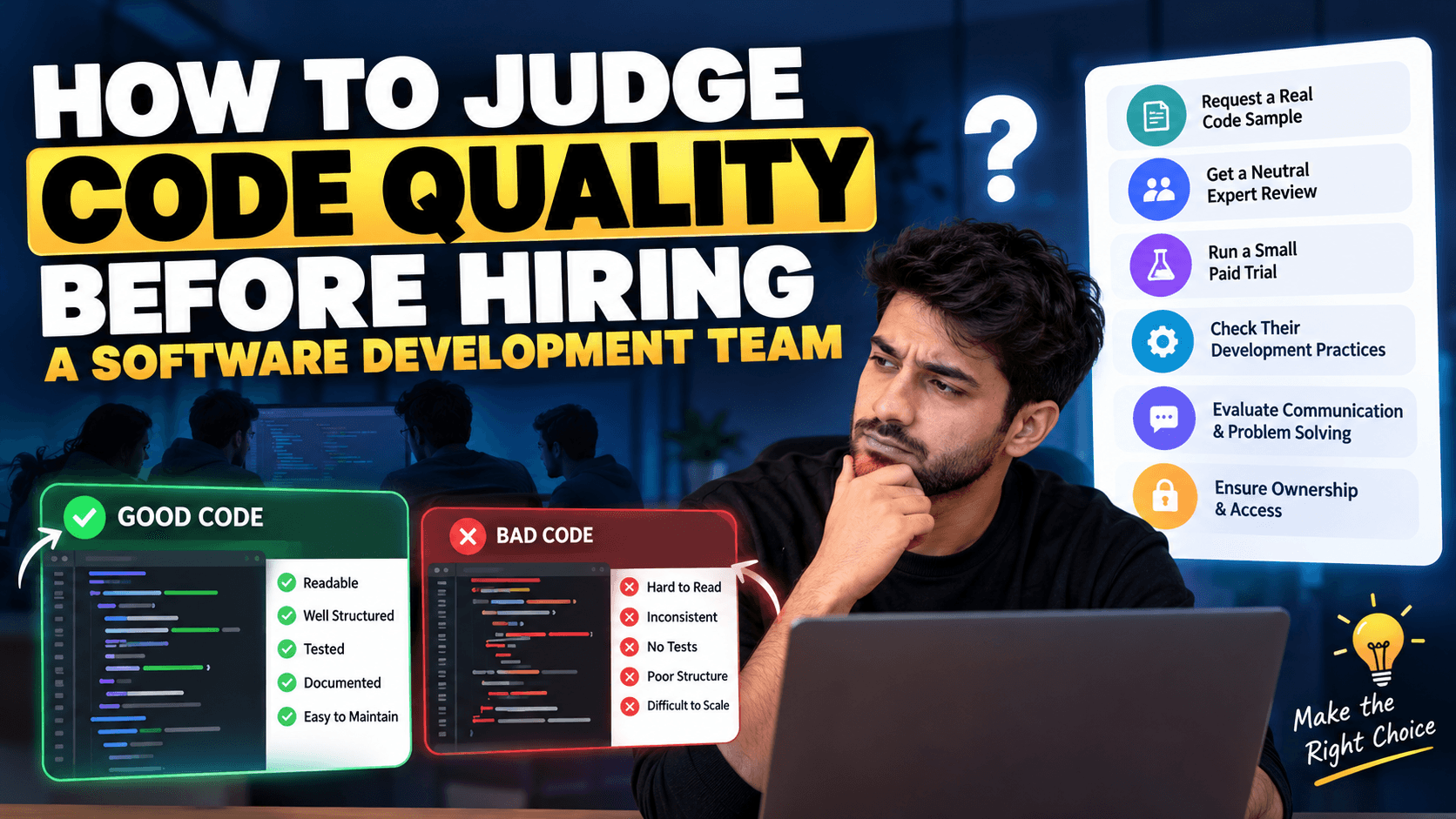
Request a representative sample of the team's work: ideally a recent project, or a meaningful portion of one, that resembles what you'll be building. Then don't try to judge it alone. Bring in a neutral senior engineer — a technical advisor, a fractional CTO, or a trusted contact — for a short paid review. A good reviewer can tell you a great deal in an hour or two by looking for:
- Readability — can a new developer follow what the code does without a guided tour? Clear names and consistent structure matter more than cleverness.
- Consistency — does the codebase follow one set of conventions, or does it look like five people doing five different things?
- Separation of concerns — is the logic organized into sensible pieces, or is everything tangled together where one change ripples everywhere?
- Error handling — does the code anticipate things going wrong, or does it assume everything always works?
- Comments and documentation — are the non-obvious decisions explained?
If a team won't share any sample at all, that's a meaningful signal in itself.
Run a small paid trial before the big commitment
The single most reliable test is a small, paid piece of real work before you sign a long engagement. A one-to-two-week trial on a genuine task tells you more than any portfolio. Watch for:
- How they scope and estimate the work, and whether reality matches the estimate.
- Whether they ask good clarifying questions or just start building assumptions.
- The quality of what they deliver — does it work on the first try, and is it easy to review?
- How they communicate progress, blockers, and trade-offs along the way.
A trial costs a little money and a little time. Hiring the wrong team costs far more.
Look for the habits that produce quality
Quality isn't an accident; it comes from practices. You don't have to understand the practices deeply to confirm a team actually uses them. Ask direct questions and listen for specific, confident answers rather than vague reassurance:
Automated testing
Ask what they test automatically and how. Teams that test catch problems before you do. Teams that rely on manual clicking ship bugs to your users. You're looking for evidence that tests exist and run regularly — not a specific coverage number.
Code review
Ask whether every change is reviewed by another engineer before it ships. Peer review is one of the simplest, strongest predictors of healthy code. A team where one person writes everything unchecked is a risk.
Version control and deployment
Ask how they track changes and release updates. You want to hear that they use proper version control, that they can see who changed what and why, and that deploying isn't a scary manual ritual. Smooth, frequent, reversible releases are a sign of a mature team.
Documentation and handover
Ask what you'd receive if you parted ways tomorrow. A professional team can hand over a documented, runnable project. If the answer is fuzzy, you may be buying a black box you can never leave.
Watch how they handle being questioned
Technical skill matters, but so does temperament. Push gently on a decision and see how the team responds. Do they explain their reasoning clearly and welcome the scrutiny, or do they get defensive and bury you in jargon? The best teams are comfortable being questioned because they can justify their choices in plain language. You'll be working with these people under pressure — how they handle a polite challenge now is how they'll handle a real problem later.
Protect yourself on ownership and access
Before you start, make sure the arrangement protects you regardless of how the relationship goes:
- You own the code and the IP. Get it in writing that everything built for you belongs to you.
- You hold the accounts. Your code repository, hosting, and domains should live in accounts you control, with the team added as collaborators — not the other way around.
- You can get everything out. Confirm you could hand the project to another team without losing access or history.
These aren't signs of distrust; they're standard professional practice, and a good partner will expect them.
Red flags worth walking away from
- Refusing to share any sample work or references.
- No automated testing and no code review, defended as unnecessary.
- Estimates that sound too good and come with no questions.
- Vague answers about ownership, access, or handover.
- Defensiveness when you ask reasonable questions.
- Pressure to skip a trial and sign a long contract immediately.
Green flags worth paying for
- Happy to show real work and connect you with past clients.
- Clear, specific answers about how they test, review, and deploy.
- Thoughtful questions about your goals before quoting anything.
- Comfortable with a paid trial and with you owning everything.
- Honest about trade-offs and what they'd do differently.
How Datricle approaches this
At Datricle we build web and mobile apps, SaaS products, and AI systems, and we provide dedicated development teams that work as an extension of your own. We'd rather you check our work than take our word for it — so we're glad to walk through real projects, explain how we test and review, start with a small scoped engagement, and make sure you own your code and accounts from day one. If you're evaluating partners right now, use the checklist above on every one of us. The teams worth hiring will welcome it.
Work with Datricle
Planning a product or need engineering capacity?
Datricle builds AI-powered software, SaaS platforms and web & mobile apps — and provides dedicated development teams that plug into your roadmap. Book a free consultation and get clear guidance, timelines and a plan.
Explore: our services, case studies and dedicated development teams.