
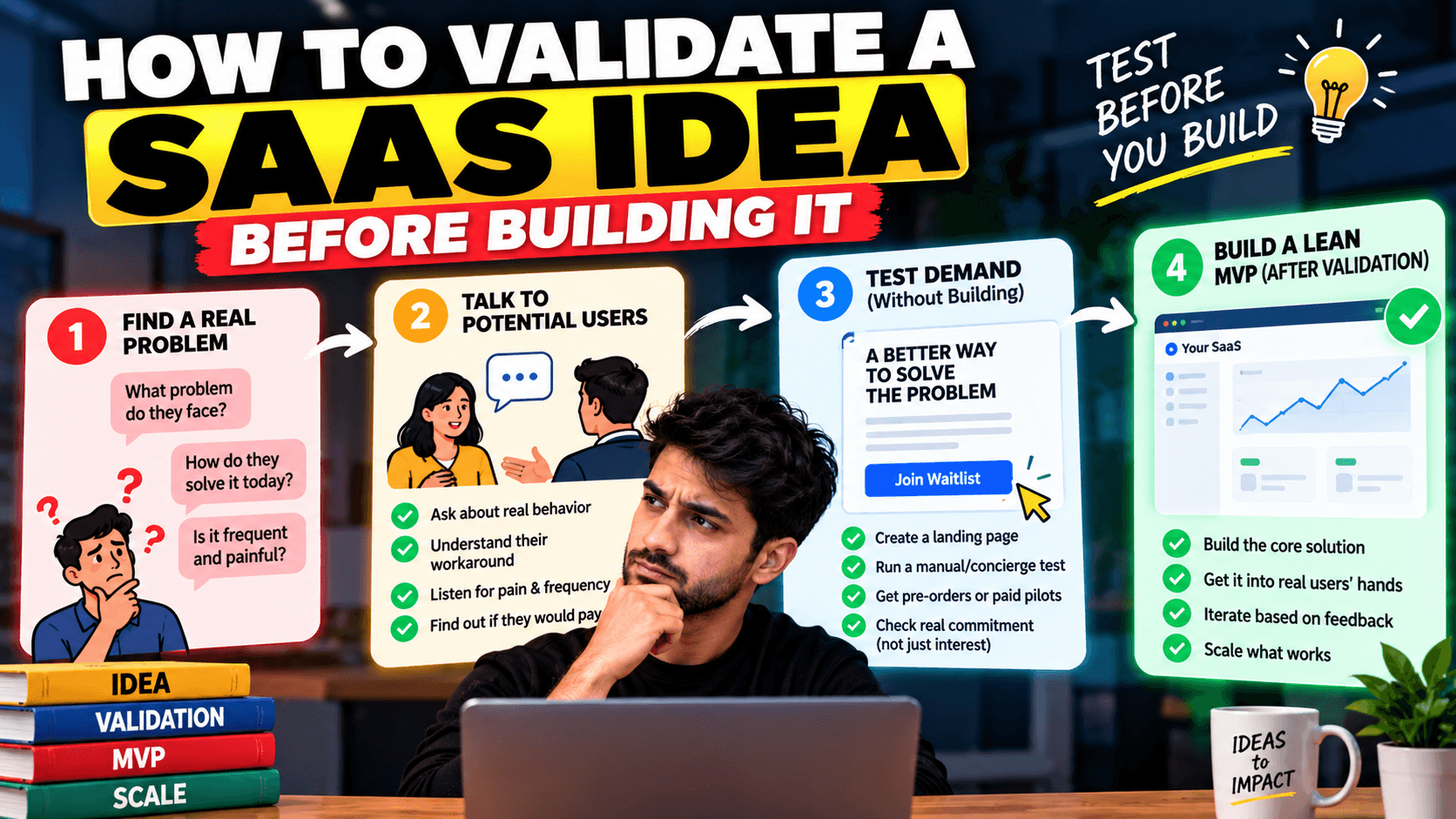
How to Validate a SaaS Idea Before You Build It
A practical, step-by-step way to prove demand before spending time and budget on development.
Datricle • 16 Oct 2026
The short answer: you validate a SaaS idea before building it by proving that a specific group of people has a painful, frequent problem they are already trying to solve — and that they would pay for a better solution. You do this through direct conversations, a simple landing page, and small manual tests, long before you write production code. The goal of validation is not to confirm you are right; it is to find the fastest, cheapest way to discover whether you are wrong.
Skipping this step is the most expensive mistake founders make. Building first and validating later means you can spend months and your entire budget creating something nobody needs. Below is a practical sequence any founder can follow to pressure-test an idea before committing to development.
What "validation" really means
Validation is evidence that three things are true at the same time:
- The problem is real. A specific group feels genuine, recurring pain — not a mild inconvenience.
- They are already acting on it. People are using spreadsheets, hiring help, or cobbling together tools to cope. Existing effort is the clearest signal that a problem matters.
- They will pay. Interest is cheap; willingness to pay, commit time, or pre-order is the signal that counts.
An idea is validated when you have real evidence for all three — not when friends say "that sounds cool." Enthusiasm is not demand.
Step 1: Define the problem and who has it
Start by writing one plain sentence: "[specific type of person] struggles to [do something] because [reason], and today they handle it by [current workaround]." If you cannot fill that in precisely, you are not ready to build — you are ready to learn.
The sharper your target, the easier everything else becomes. "Small business owners" is too broad to reach or serve well. "Independent bookkeepers managing 10 to 30 clients" is specific enough to find, talk to, and build for. Narrow is not a limitation at this stage; it is an advantage.
Step 2: Talk to real potential customers
Nothing replaces direct conversations with people who have the problem. Aim for honest discovery, not a sales pitch. The most useful questions are about the past and present, not the hypothetical future.
- Ask about behavior, not opinions. "Walk me through the last time you dealt with this" beats "Would you use a tool that does X?"
- Dig into the workaround. What do they use today, what does it cost them in time or money, and what do they hate about it?
- Listen for emotion and frequency. Problems people describe with frustration, and face often, are the ones worth solving.
- Avoid leading questions. If you hint at the answer you want, people will give it to you — and the data will be worthless.
A dozen focused conversations will teach you more than any amount of guessing. Patterns emerge quickly: either the same pain keeps surfacing, or it does not.
Step 3: Test demand before you build
Once you believe the problem is real, test whether people actually want a solution — still without building the full product. Several lightweight methods work well, and you can combine them.
A landing page
Create a simple page that clearly describes the problem and your proposed solution, with a single call to action — join the waitlist, request access, or see pricing. Drive a small amount of targeted traffic to it. Sign-ups from strangers who do not know you are a far stronger signal than encouragement from your network.
The "concierge" or manual test
Deliver the outcome by hand before automating it. If your idea is software that generates reports, make the reports manually for a few early users. If people value the result enough to pay or keep coming back, you have proof the outcome matters — and you have learned exactly what to build.
A pre-sale or commitment
The strongest validation is someone putting something at stake: a pre-order, a paid pilot, a deposit, or a signed letter of intent. Money and time are honest. If people will not commit when it is easy to say yes, that is valuable information before you spend on development.
Step 4: Decide with a clear threshold
Before you run these tests, decide what result would make you proceed, pivot, or stop. Setting the bar in advance keeps you honest when the data arrives, because it is tempting to interpret weak results optimistically.
Watch for these healthy signals: people describe the problem without prompting, existing workarounds are clearly painful, strangers sign up or commit, and early users come back or ask when they can pay. Warning signs include polite interest with no action, every conversation describing a different problem, and people liking the idea but never prioritizing it.
Common validation mistakes
- Only asking friends and family. They want to support you, so they are the least reliable source of truth.
- Confusing interest with demand. "I'd use that" is not the same as "here's my card."
- Building an MVP that is secretly the full product. If your "minimum" test takes six months, it is not a test.
- Asking leading questions. You will hear what you want and learn nothing.
- Treating validation as a one-time gate. Keep testing assumptions as you build — the first version is a hypothesis, not a conclusion.
From validated idea to first build
Once the evidence is convincing, the goal shifts to building the smallest version that solves the core problem for your earliest users — a true minimum viable product, not a feature-complete platform. Validation tells you what that core is: the one outcome people proved they care about. Build that, get it into real hands, and let continued usage guide what comes next. Everything beyond the core can wait until paying users ask for it.
This is also the point where good technical guidance pays off. Scoping an MVP tightly — so it is genuinely minimal but still delivers the validated outcome — is a skill, and over-building here is how early budgets disappear.
Where Datricle fits in
At Datricle, we help founders move from a validated idea to a focused first product without over-building. We work as an extension of your team to scope a lean MVP around the outcome your validation proved people want, build it quickly, and set it up to evolve as real users respond. If you have done the customer conversations and early demand tests and are ready to build — or you want a technical partner to help shape the smallest version worth shipping — we can help you get there efficiently, whether that means a single MVP or a dedicated development team to scale once you have traction.
If you are still at the idea stage, the best next step costs nothing: write your one-sentence problem statement and go talk to ten people who have that problem. What you learn will shape everything you build next.
Work with Datricle
Planning a product or need engineering capacity?
Datricle builds AI-powered software, SaaS platforms and web & mobile apps — and provides dedicated development teams that plug into your roadmap. Book a free consultation and get clear guidance, timelines and a plan.
Explore: our services, case studies and dedicated development teams.