
How to Protect Your IP With an Outsourced Dev Team
The contracts, access controls, and working practices that keep your code, data, and ideas firmly yours.
Datricle • 10 Oct 2026
You protect your intellectual property when outsourcing software by combining the right contracts (IP assignment, NDA, and confidentiality clauses), disciplined access control, and clear working practices — before a single line of code is written. IP protection isn't one document you sign at kickoff; it's a layered approach across legal, technical, and operational practices. Done well, you get the speed and scale of an external team without giving up ownership of your code, data, or ideas. This guide covers exactly what to put in place.
First, understand what "your IP" actually includes
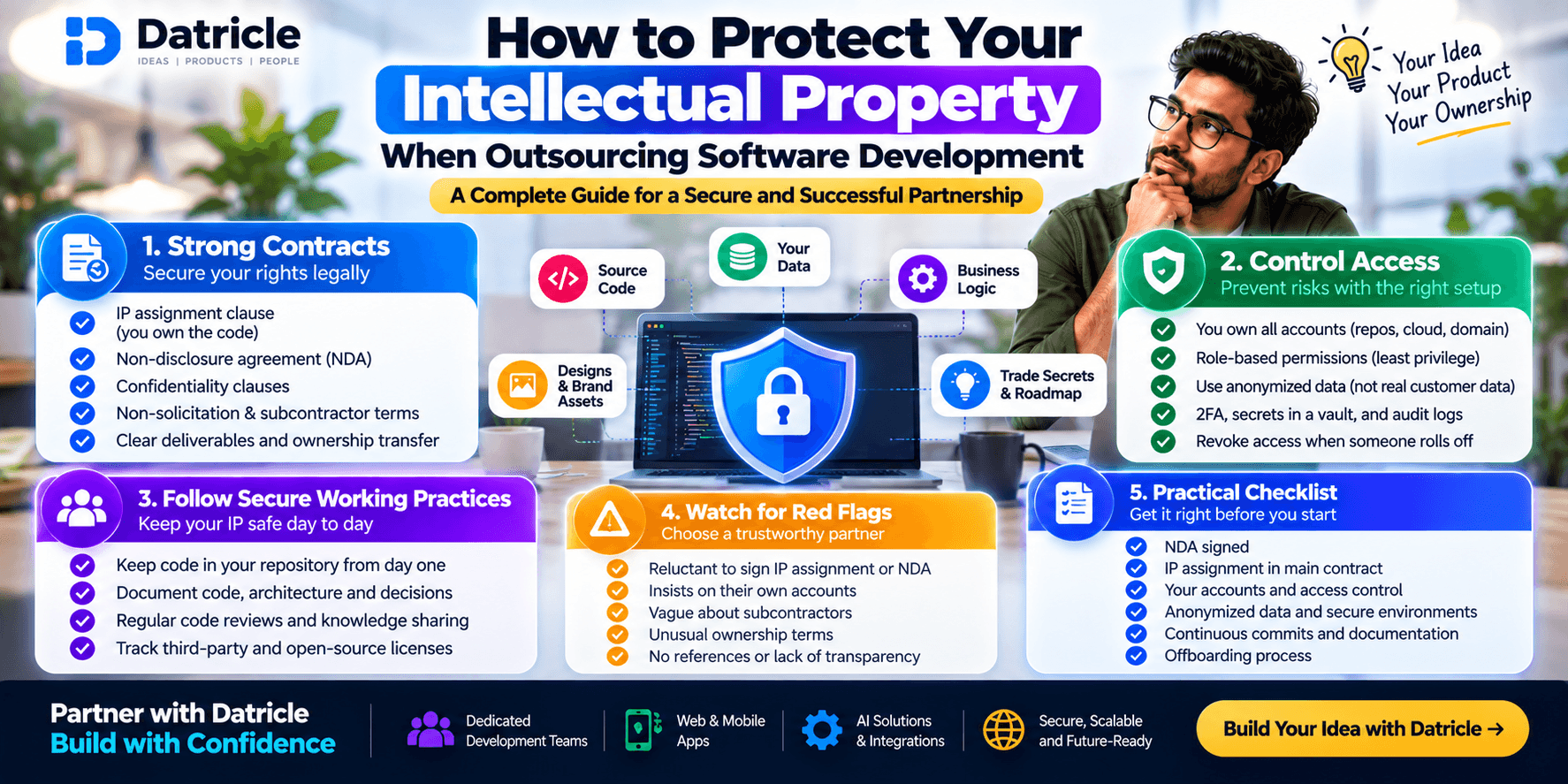
When people worry about IP in a development engagement, they're usually protecting several different things at once:
- Source code and architecture written for your product.
- Your data — customer records, proprietary datasets, and anything that flows through the system.
- Business logic and know-how — the workflows, pricing, and domain insight that make your product distinct.
- Brand assets and designs — logos, UI, and copy.
- Trade secrets and roadmap — what you're building next.
Each needs a slightly different safeguard. A strong contract covers code ownership; access controls protect data; good process protects know-how. Treat them as a set, not a single checkbox.
The contracts that matter
Get legal advice for your specific jurisdiction, but these are the instruments you'll almost always want in place:
- IP assignment clause. This is the most important one. By default, in many jurisdictions the party that writes code may retain certain rights. A clear "work made for hire" or present-tense assignment ("Contractor hereby assigns all right, title, and interest...") ensures ownership transfers to you. Make sure it covers all deliverables and any pre-existing tools the vendor incorporates (via a license, at minimum).
- Non-disclosure agreement (NDA). Signed before you share anything sensitive — ideally before the first discovery call. It should survive the end of the engagement.
- Confidentiality clauses in the master agreement. Reinforce the NDA inside the main contract and bind the vendor's individual team members, not just the company.
- Non-solicitation and subcontractor terms. Clarify whether work can be subcontracted, and require any subcontractors to be bound by the same IP and confidentiality terms.
- Clear deliverables and acceptance. Define what you're paying for and when ownership transfers (commonly on payment). Avoid clauses that let the vendor withhold code or retain a lien over deliverables.
Control access — don't rely on trust alone
Contracts give you recourse after something goes wrong. Access control prevents it from happening. The principle is least privilege: people get only the access they need, for only as long as they need it.
- You own the accounts. Keep your source repository, cloud infrastructure, domain, and app store accounts under your organization. Invite the team as collaborators rather than handing over root ownership.
- Use role-based permissions. Grant repository and infrastructure access by role, and remove it the day someone rolls off.
- Separate production data. Developers rarely need real customer data. Use anonymized or synthetic data in development and staging environments.
- Enforce the basics: SSO where possible, mandatory two-factor authentication, secrets stored in a vault (never in code), and audit logs you can review.
- Offboard deliberately. Maintain a checklist to revoke every credential when a person or the engagement ends.
Working practices that keep IP safe
Day-to-day habits matter as much as paperwork:
- Keep the repository yours from day one. Code should land in your repo continuously, not arrive as a zip file at the end. This guarantees you always hold the latest work and the full history.
- Document as you go. Require readable code, commit history, and basic architecture docs so the product isn't trapped in one vendor's head. This also protects you against lock-in.
- Review and retain knowledge. Regular code reviews and a shared knowledge base mean the understanding stays with you even as individuals change.
- Be deliberate about third-party and open-source components. Ask the team to track dependencies and licenses so you don't inadvertently inherit a license that conflicts with your business model.
Watch for these red flags
Some warning signs are worth taking seriously before you commit:
- A vendor reluctant to sign a clear IP assignment or NDA.
- Insistence on holding the source repository or infrastructure in their accounts.
- Vague answers about subcontractors or where the work is actually performed.
- Contracts that delay or condition ownership transfer in unusual ways.
- No willingness to provide references or show how they've handled confidentiality before.
A reputable partner expects these questions and answers them plainly. Transparency early is one of the best signals of a trustworthy team.
Jurisdiction and enforcement
Where your partner operates affects how you enforce your rights. Define the governing law and dispute-resolution venue in the contract, and understand that cross-border enforcement can be slower and costlier than domestic. This is one reason prevention — strong contracts plus tight access control — beats relying on litigation. Choosing an established partner with a track record and a real business presence also reduces risk, because reputation is itself a powerful incentive to behave well.
A practical checklist
- NDA signed before sharing anything sensitive.
- Master agreement with present-tense IP assignment and confidentiality binding individual team members.
- Clear terms on subcontracting, deliverables, and when ownership transfers.
- Your organization owns all repos, cloud, domain, and app store accounts.
- Least-privilege access, 2FA, secrets in a vault, and audit logs.
- Anonymized data in non-production environments.
- Continuous commits to your repo and documentation as you go.
- An offboarding checklist to revoke access cleanly.
How Datricle approaches it
At Datricle, we build software as an extension of our clients' teams, and we treat IP protection as a default, not an upsell. That means clear IP assignment and confidentiality terms, code committed directly to your repositories under your ownership from day one, least-privilege access to your infrastructure, and documentation that keeps knowledge with you rather than locked inside any individual. Whether you engage a dedicated development team or a scoped project, the outcome is the same: you move fast and you own everything you pay for. If you're planning to outsource and want to get the safeguards right before kickoff, that groundwork is exactly where a good partner should start.
Work with Datricle
Planning a product or need engineering capacity?
Datricle builds AI-powered software, SaaS platforms and web & mobile apps — and provides dedicated development teams that plug into your roadmap. Book a free consultation and get clear guidance, timelines and a plan.
Explore: our services, case studies and dedicated development teams.