
How Much Does It Cost to Build a SaaS MVP?
What actually drives the price, a realistic range, and how to keep your MVP affordable without cutting corners.
Datricle • 30 Sept 2026
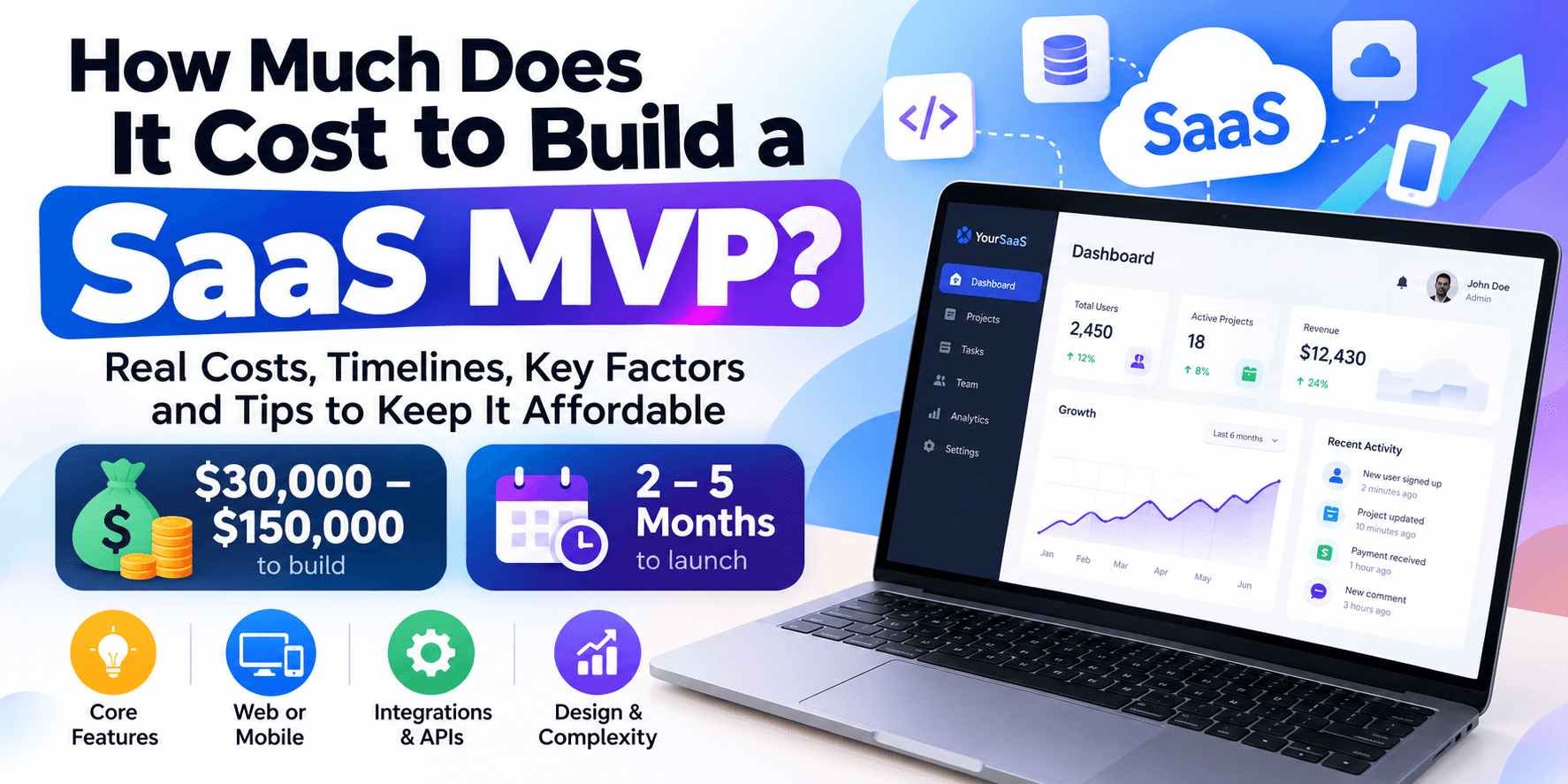
The short answer: most SaaS MVPs cost somewhere between roughly $30,000 and $150,000 to build to a launchable state, and take about two to five months. Where you land in that range depends on a handful of concrete factors — how many core features you truly need at launch, whether you need mobile as well as web, how much integration and compliance is involved, and who builds it. A lean, focused MVP with a small experienced team sits at the low end; a data-heavy or regulated product with real-time features and integrations sits at the high end.
That's a wide range, and the reason is simple: "SaaS MVP" describes everything from a single-purpose web tool to a multi-tenant platform. The useful question isn't "what does an MVP cost" in the abstract — it's "what drives the cost, and how do I keep mine on the low end without cutting the things that matter." This post breaks that down.
What actually drives the cost
Your budget is mostly determined by scope and by the rate of whoever builds it. Here are the biggest levers, in roughly the order they move the number.
Number and complexity of core features
Every screen, workflow, and rule is design, build, and test time. The single most effective cost control is ruthless prioritization: an MVP should do one job well, not five jobs adequately. A login, a core workflow, and a simple dashboard is a very different budget from that plus messaging, analytics, admin tooling, and role-based permissions.
Platforms: web, mobile, or both
A responsive web app is one build. Adding native iOS and Android roughly increases front-end effort. Many SaaS MVPs launch web-first for exactly this reason, adding mobile once the product has traction.
Integrations and third-party services
Payments, email, calendars, CRMs, and other APIs each add integration and testing work. Using established services (for authentication, payments, and email, for example) is almost always cheaper than building those pieces yourself.
Data, real-time, and AI features
Simple create-read-update-delete screens are inexpensive. Real-time collaboration, complex reporting, or AI-powered features add architectural work and ongoing cost, and are worth including at MVP stage only if they're central to the value.
Design
A clean, usable interface built on a component library is efficient. Bespoke, highly polished design and custom animation cost more. For an MVP, usable and consistent beats pixel-perfect.
Non-functional requirements
Security, compliance (SOC 2, HIPAA, GDPR), high availability, and heavy automated testing all add cost. Some are non-negotiable for your market; know which apply to you before you scope, because retrofitting them later is far more expensive.
Who builds it changes the number
The same MVP costs very different amounts depending on the team:
- Solo founder or technical co-founder — lowest cash cost, but slow, and it depends entirely on one person's availability and skill range.
- Freelancers — flexible and often affordable, but you carry the coordination, architecture, and quality risk yourself.
- In-house team — great for the long term, but hiring takes months and carries salary, benefits, and management overhead well before you've validated the product.
- Development agency or dedicated team — a ready-made group that can start quickly, bring product and technical experience, and scale up or down. Rates vary widely by region, which is one of the largest single factors in your total.
Rates differ dramatically by geography for comparable skill, which is why many startups build with a dedicated team in a cost-effective region while keeping product ownership in-house. The goal is the right blend of experience, speed, and rate — not simply the cheapest hourly number, since inexperienced-but-cheap often costs more once you account for rework.
A realistic way to think about the range
Rather than a single figure, think in tiers based on scope:
- Lean MVP — one core workflow, web only, standard integrations, using off-the-shelf services. Fastest and cheapest; ideal for testing a single hypothesis.
- Standard MVP — several connected workflows, user roles, a real dashboard, a few integrations, solid design. This is where most funded early-stage products land.
- Complex MVP — real-time features, AI, heavier data, mobile plus web, or compliance requirements. Higher cost and longer timeline, justified when those features are the product's core value.
Two products can both be "MVPs" and differ by 5x in cost purely because of which tier they're in. Knowing your tier before you ask for quotes is what makes those quotes comparable.
The costs founders forget
Build cost is not total cost. Budget for these too:
- Product discovery — a short phase to nail down scope before building. It costs a little up front and routinely saves far more by preventing the wrong thing from being built.
- Infrastructure and third-party fees — hosting, databases, email, payments, and monitoring are ongoing monthly costs that scale with usage.
- Maintenance and iteration — an MVP that gets traction needs fixes and new features. Plan for continued development, not a one-time build.
- Quality assurance — testing isn't optional; skipping it just moves the cost to bug-fixing and lost users later.
How to keep an MVP affordable without gutting it
- Cut features, not quality. Ship fewer things that work well rather than many that are half-built.
- Buy before you build. Use proven services for auth, payments, and email instead of writing them from scratch.
- Choose a stack the market supports. A mainstream, well-supported technology stack keeps hiring easy and iteration fast.
- Do a discovery phase first. A clear spec and prototype reduce expensive mid-build changes.
- Start web-first. Add mobile once you have signal that people want the product.
- Pick a team that's built SaaS before. Experience shows up as fewer wrong turns, which is where budgets quietly disappear.
How Datricle can help
Datricle builds SaaS MVPs for startups and enterprises worldwide — web and mobile apps, AI features, and workflow automation — and can act as a dedicated development team that works as an extension of yours. We start with a discovery phase to lock scope and give you a realistic estimate before a line of production code is written, then build in focused iterations so you launch faster and spend on the features that actually validate your idea. Whether you need a lean web-first MVP or a more complex platform with integrations and AI, we can help you scope it to your budget and build it to last.
The most useful next step is a short conversation about your idea and your must-have features. From there we can give you a scoped estimate tailored to your product, rather than a generic range — so you know what your MVP will actually cost before you commit.
Work with Datricle
Planning a product or need engineering capacity?
Datricle builds AI-powered software, SaaS platforms and web & mobile apps — and provides dedicated development teams that plug into your roadmap. Book a free consultation and get clear guidance, timelines and a plan.
Explore: our services, case studies and dedicated development teams.