
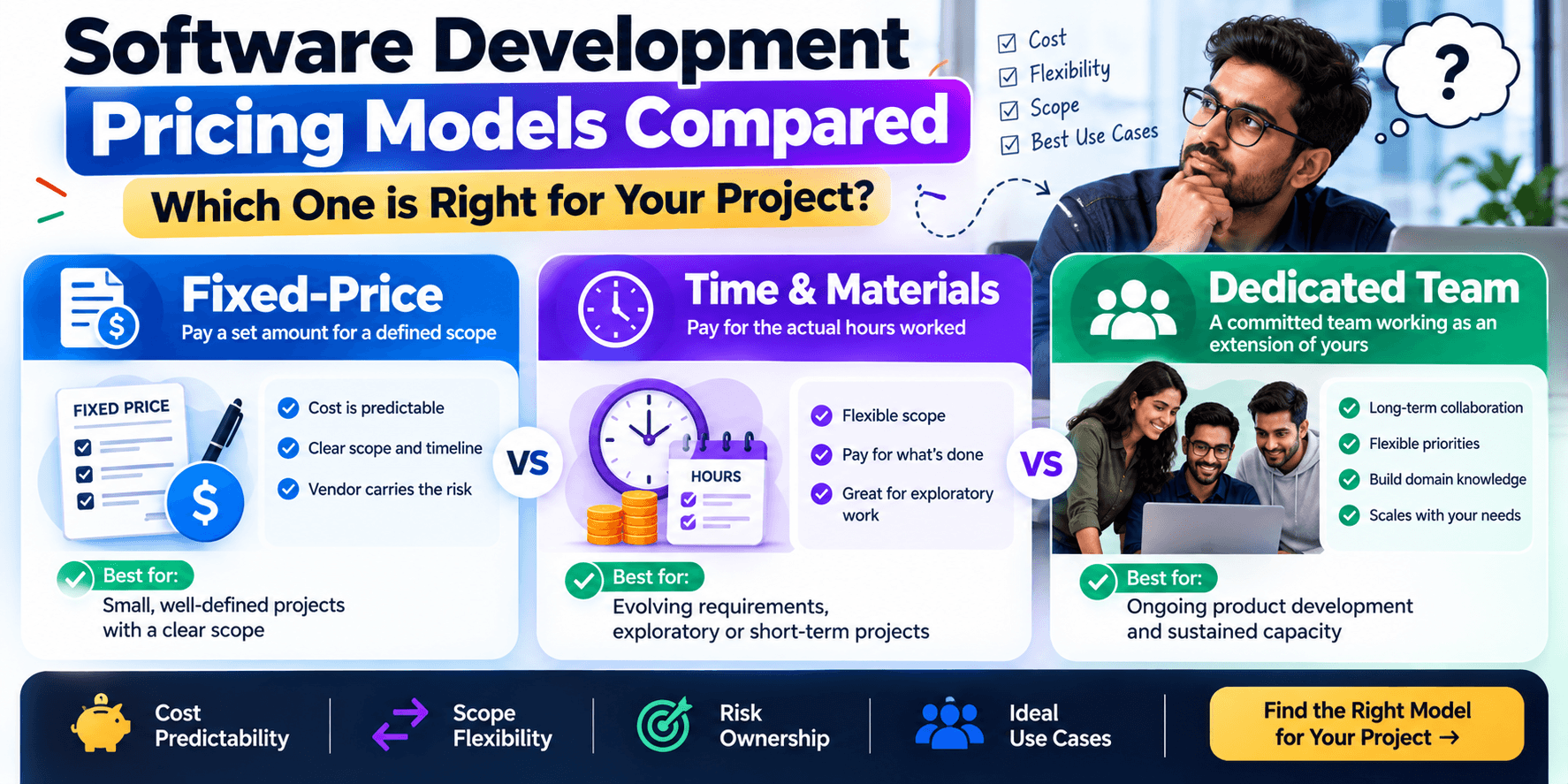
Fixed-Price vs T&M vs Dedicated Team: Which to Pick
How to match a software development contract model to your project's stage and risk.
Datricle • 4 Oct 2026
If you're choosing how to pay for software development, the short answer is this: use fixed-price when the scope is small, well-defined, and unlikely to change; use time-and-materials when the work is exploratory or the scope will evolve; and use a dedicated team when you need sustained capacity over months and want to steer priorities as you go. Most growing products end up on a dedicated-team model because real software is rarely finished in one fixed burst.
The contract model you pick shapes who carries the risk, how much flexibility you have, and how closely you can steer the work. Here's how the three common models actually behave in practice, and how to match one to your situation.
Fixed-price: pay a set amount for a defined scope
In a fixed-price arrangement, you agree on a detailed specification up front, and the vendor commits to delivering it for an agreed amount. It's attractive because the number is predictable and the vendor carries the risk of overruns.
Where it works well:
- A clearly bounded project — a marketing site, a specific integration, a well-understood feature.
- Scope that genuinely won't change once work begins.
- Situations where you need budget certainty for approval.
Where it breaks down:
- Because the price is fixed, every change becomes a negotiation. Realistic products change constantly, so you end up in a stream of change requests.
- Vendors price in risk, so a fixed quote is often higher than the work would otherwise cost.
- It incentivizes meeting the letter of the spec, not building the best product — corners get cut to protect the margin.
- It demands a complete, correct specification before anyone has learned anything from building, which is rarely how good software emerges.
Fixed-price suits a contractor-style job with firm edges. It fits product development poorly.
Time-and-materials: pay for the hours worked
Here you pay for actual effort — typically an hourly or daily rate — plus any materials. Scope can flex as you learn, and you only pay for what's done.
Where it works well:
- Exploratory or R&D work where you can't fully specify the outcome in advance.
- Projects where requirements will evolve based on user feedback.
- Short, variable engagements, or filling a specific gap.
Trade-offs to watch:
- Total cost is less predictable, so you need active budget oversight.
- Without clear priorities and regular check-ins, hours can drift. The model rewards discipline on your side — a clear backlog and a product owner who makes decisions.
- You carry more of the planning responsibility than you do under fixed-price.
Time-and-materials trades certainty for flexibility. That's usually the right trade when you're still discovering what to build.
Dedicated team: a committed team working as an extension of yours
A dedicated team is a group of developers (and often designers, QA, and a project lead) who work consistently on your product, usually billed per person per month. They're not juggling other clients; they integrate with your process, join your standups, and build domain knowledge over time.
Where it works well:
- Ongoing product development with a roadmap that spans months or longer.
- When you want to set and reorder priorities week to week without renegotiating a contract.
- Scaling engineering capacity quickly without the time and overhead of permanent hiring.
- When institutional knowledge matters — the same people getting faster as they learn your system.
Trade-offs to watch:
- It's a commitment to capacity, so it suits sustained work rather than a tiny one-off.
- You get the most value when you treat the team as your own — clear ownership, good communication, and real decisions — rather than as an arm's-length vendor.
The dedicated model combines flexibility with stability: predictable monthly capacity, full control over priorities, and a team that compounds in effectiveness the longer it works with you.
How the three compare at a glance
- Who carries scope risk? Fixed-price: the vendor. Time-and-materials: you. Dedicated team: shared, managed through your priorities.
- How flexible is the scope? Fixed-price: rigid. Time-and-materials: high. Dedicated team: high.
- How predictable is the cost? Fixed-price: very (until change requests). Time-and-materials: least. Dedicated team: predictable per month.
- Best for: Fixed-price: bounded one-off work. Time-and-materials: exploratory or short engagements. Dedicated team: sustained product development.
A simple way to decide
- Is the scope small, firm, and unlikely to change? Fixed-price is reasonable.
- Is it exploratory or short, with evolving requirements? Time-and-materials fits.
- Do you need sustained capacity and want to steer priorities over months? A dedicated team is almost always the better fit — and the most common choice for companies building and growing a real product.
You can also mix models. Many teams scope an initial discovery or prototype on time-and-materials, then move to a dedicated team once the direction is clear and the work becomes ongoing.
Beyond the contract: what actually determines success
The model matters, but it's not the whole story. The outcomes you get depend just as much on communication cadence, how clearly priorities are set, code quality standards, how knowledge is documented, and how well the team integrates with your own people. A well-run time-and-materials engagement beats a poorly managed fixed-price one every time. Before you sign anything, ask how the vendor handles changing requirements, reporting, code ownership, and the transition if you ever part ways.
How Datricle can help
At Datricle, we offer dedicated development teams that work as an extension of your team, along with flexible engagement models for more defined pieces of work. We help startups and enterprises worldwide figure out which model fits the stage they're at — whether that's a focused build with a clear spec or an ongoing team that scales with your roadmap — and then deliver with the communication and quality practices that make any model work. If you're weighing how to structure your next engagement, we're glad to talk it through and recommend the approach that fits your goals, not just our billing.
Work with Datricle
Planning a product or need engineering capacity?
Datricle builds AI-powered software, SaaS platforms and web & mobile apps — and provides dedicated development teams that plug into your roadmap. Book a free consultation and get clear guidance, timelines and a plan.
Explore: our services, case studies and dedicated development teams.