
Fixed-Price vs T&M vs Dedicated Team: How to Choose
A practical guide to picking the software engagement model that fits your scope and goals.
Datricle • 9 Oct 2026
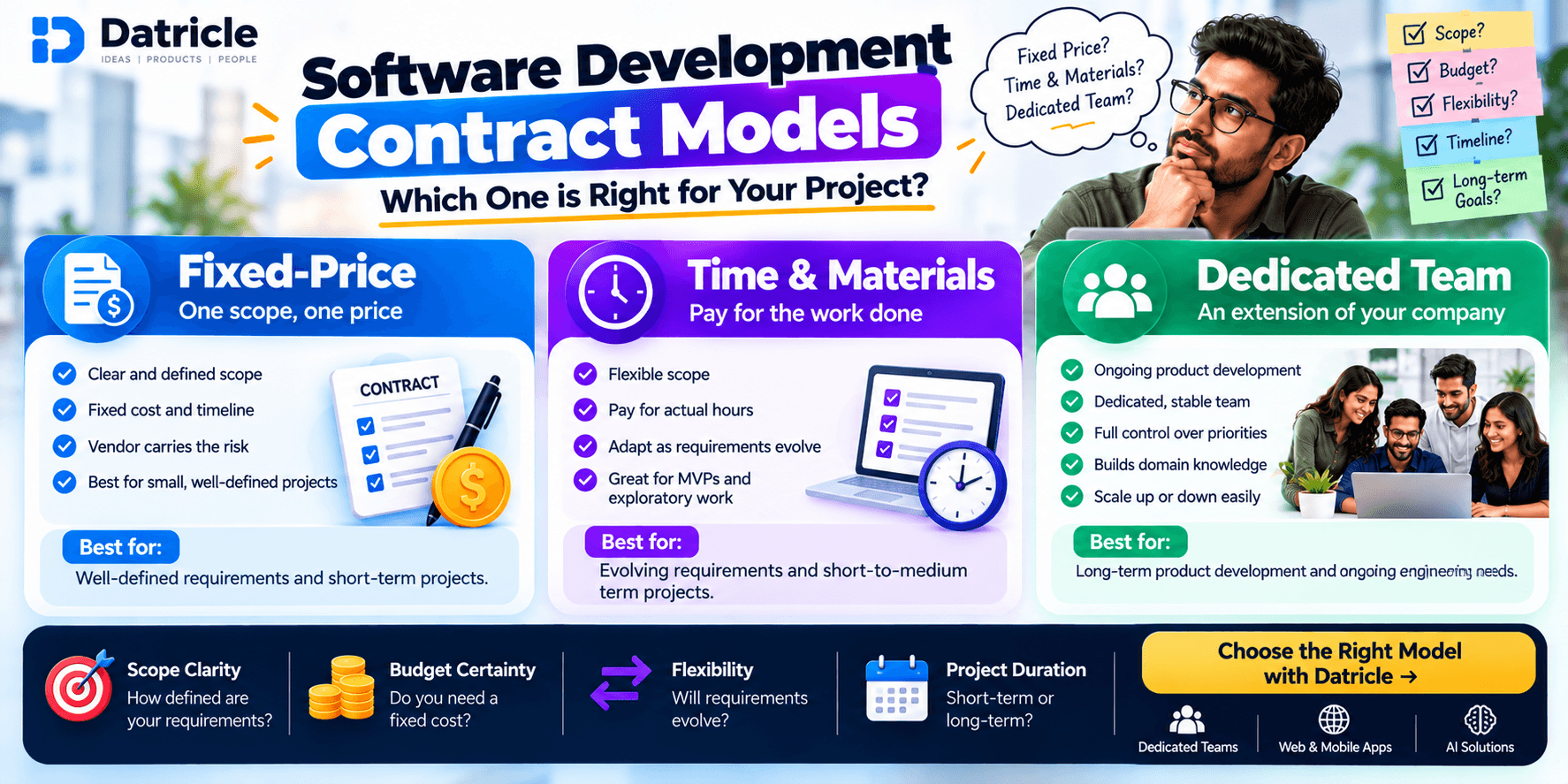
Short answer: There is no single "best" contract model — the right choice depends on how well-defined your scope is and how much flexibility you need. Use fixed-price when the scope is small, clear, and unlikely to change. Use time-and-materials when the work is exploratory or evolving. Use a dedicated team when you need ongoing capacity and want to treat engineers as a long-term extension of your own team. Picking the wrong model is one of the quietest ways software projects go over budget and over time.
Below is a practical breakdown of each model, what it's good and bad at, and how to decide.
Fixed-price: pay a set amount for a defined scope
In a fixed-price engagement, you agree on a detailed specification up front and the agency commits to delivering it for an agreed amount. You know the total cost before work begins, which makes budgeting simple and shifts delivery risk onto the vendor.
That certainty comes with trade-offs. Fixed-price only works when the scope is genuinely well understood — every assumption has to be nailed down in advance, because anything not in the spec becomes a change request with its own negotiation and cost. It also tends to discourage flexibility: once the contract is signed, changing direction is expensive and slow, even when you've learned something that should change the plan.
Fixed-price fits best when:
- The requirements are clear, stable, and documented in detail.
- The project is relatively small and short.
- You value budget certainty over flexibility.
- You're building something well-trodden rather than novel.
Be cautious if: your requirements are still forming, the product is innovative, or you expect to iterate based on user feedback. In those cases, a fixed price usually either pads the budget to cover risk or leads to a cycle of change requests.
Time-and-materials: pay for the hours actually worked
With time-and-materials (T&M), you pay for the time spent and resources used, typically at an agreed hourly or daily rate. There's no rigid upfront scope; work proceeds in iterations, and you can adjust priorities as you learn.
The strength of T&M is flexibility. You can start before every detail is settled, change direction as requirements evolve, and stop or pivot when priorities shift. The trade-off is less cost certainty: the final total depends on how much work is ultimately needed, which demands trust and active involvement from you. Good T&M engagements rely on transparency — clear reporting, regular check-ins, and a shared backlog so you always know what you're paying for.
Time-and-materials fits best when:
- The scope is uncertain, exploratory, or expected to evolve.
- You're building an MVP or iterating based on user feedback.
- You want to start quickly without a lengthy specification phase.
- You're able to stay involved and make decisions as the work progresses.
Be cautious if: you need a firm budget cap, or you can't commit time to steer the work. T&M without engagement can drift. Many teams mitigate the risk by setting a budget ceiling or working in fixed-cost sprints.
Dedicated team: an ongoing extension of your own team
A dedicated team model gives you a group of engineers (and often designers, QA, and a project manager) who work exclusively on your product over an extended period, usually billed at a predictable monthly rate per person. Rather than buying a defined deliverable, you're effectively renting committed capacity that you direct.
This model shines for longer-term work. The team builds deep knowledge of your product and domain, velocity improves over time, and you keep full control over priorities and process — they plan sprints with you, join your stand-ups, and operate like your own staff without the overhead of permanent hiring. It scales up or down far faster than recruiting in-house, which is why many startups use it to grow engineering capacity quickly after a raise.
A dedicated team fits best when:
- You have ongoing development needs rather than a one-off project.
- Requirements will keep evolving and you want a team that grows with the product.
- You want day-to-day control over priorities and workflow.
- You need to scale engineering capacity quickly without long hiring cycles.
Be cautious if: you only have a small, finite piece of work. For a short, well-defined task, a dedicated team can be more commitment than you need.
How to choose: a quick decision guide
Instead of asking which model is best in the abstract, ask these questions about your situation:
- How clear is your scope? Fully defined and stable points toward fixed-price. Fuzzy or evolving points toward T&M or a dedicated team.
- How long is the engagement? Short and finite favors fixed-price or T&M; ongoing favors a dedicated team.
- How much will you be involved? Fixed-price asks the least of you day-to-day; T&M and dedicated teams reward active involvement.
- What matters more — budget certainty or flexibility? Certainty leans fixed-price; flexibility leans T&M or dedicated team.
- Is this a product or a project? A living product you'll grow suits a dedicated team; a discrete deliverable suits fixed-price or T&M.
You can mix models over the project lifecycle
These models aren't mutually exclusive, and the smartest engagements often blend them. A common pattern is to begin with a short fixed-price discovery phase to define scope and produce a clear plan, move into time-and-materials to build and iterate on an MVP while requirements are still settling, and then transition to a dedicated team once the product is live and needs steady, ongoing development. Matching the model to the stage you're in usually beats forcing one model across the entire journey.
How Datricle approaches engagement models
At Datricle, we help startups and enterprises choose the model that actually fits the work rather than defaulting to one. For teams with a crisp, bounded deliverable, a fixed scope keeps budgeting simple. For products still finding their shape, we work iteratively so you can adjust as you learn. And for companies that need durable capacity, our dedicated teams operate as a true extension of your own — aligned to your priorities, your process, and your timeline. If you're unsure which approach is right, we're glad to talk through your scope, timeline, and goals and recommend the model that gets you the most value for your budget.
Work with Datricle
Planning a product or need engineering capacity?
Datricle builds AI-powered software, SaaS platforms and web & mobile apps — and provides dedicated development teams that plug into your roadmap. Book a free consultation and get clear guidance, timelines and a plan.
Explore: our services, case studies and dedicated development teams.