
Fixed-Price vs Dedicated Team: Which to Pick
A clear breakdown of the three main software contract models and when each one actually makes sense for your project.
Datricle • 5 Oct 2026
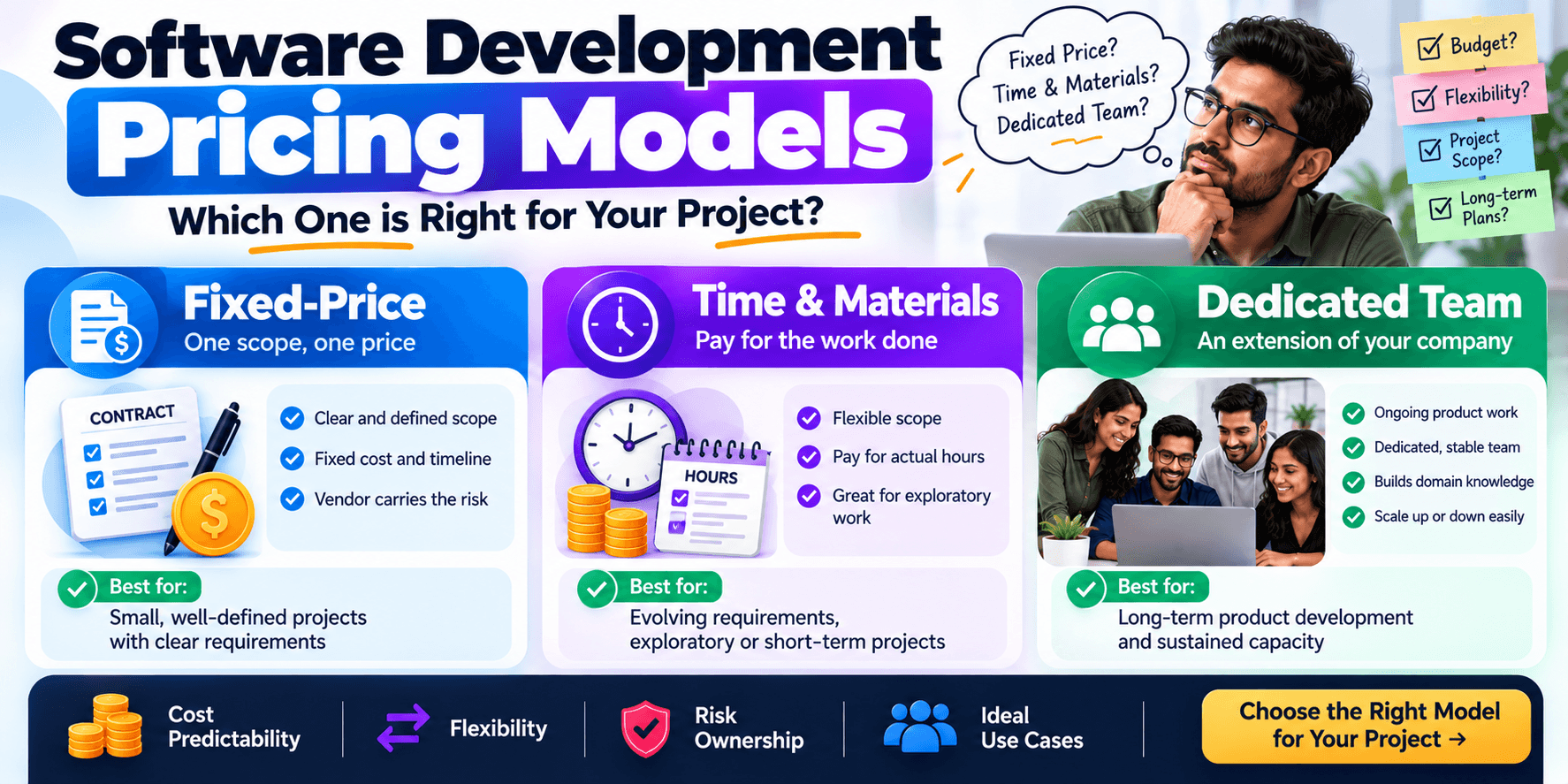
The short answer: choose fixed-price when the scope is small and fully defined, time-and-materials when the scope is likely to change and you want to pay only for work done, and a dedicated team when you have ongoing product work and want a stable group that functions as an extension of your own company. Most startups building a real product end up on time-and-materials or a dedicated team, because software scope almost always evolves.
Picking the right engagement model matters as much as picking the right agency. It shapes your cost, your flexibility, who carries the risk, and how much you'll be involved day to day. Here's how the three models actually work and how to choose between them.
Fixed-price: one scope, one price
You and the vendor agree on a detailed specification, a timeline, and a single price. They deliver that scope for that amount, regardless of how long it takes them.
It works well when:
- The requirements are clear, documented, and unlikely to change.
- The project is relatively small and self-contained—a landing site, a specific integration, a well-defined tool.
- You want budget certainty above all and can commit to not changing your mind.
The trade-offs: fixed-price pushes all the scope risk onto the vendor, so they price in a buffer—you often pay more for the certainty. Every change becomes a formal "change request" with new negotiation, which slows you down. And because the vendor is incentivized to deliver exactly the spec and move on, you can get technically-compliant work that misses the spirit of what you wanted. Fixed-price rewards finishing the document, not building the best product.
The deeper problem: fixed-price assumes you can fully specify software before building it. For anything genuinely new, you can't. You learn what to build by building, testing with users, and adjusting—exactly the things a rigid contract fights against.
Time-and-materials: pay for work done
You pay for the actual time the team spends, usually at agreed hourly or daily rates, plus any direct costs. Scope and priorities can flex as you go.
It works well when:
- The scope is uncertain or expected to evolve—most new products.
- You want to start quickly without months of up-front specification.
- You want the flexibility to reprioritize as you learn from users.
The trade-offs: you carry more of the risk, and the final cost is less predictable up front. That demands more involvement from you—reviewing progress, setting priorities, and keeping scope disciplined. The flexibility is real, but so is the responsibility: without active product ownership, time-and-materials can drift.
In practice, good vendors manage this with short sprints, clear estimates per piece of work, and regular demos, so you always see what your money produced and can steer before costs run away. Well-run, it gives you most of the control of an in-house team without the overhead of hiring.
Dedicated team: an extension of your company
You engage a stable team—developers, and often a designer, QA, and project lead—who work exclusively on your product, usually billed at a predictable monthly rate per person. They're not hired per task; they're your team for as long as you need them.
It works well when:
- You have ongoing, substantial product work—not a one-off project.
- You want deep product knowledge to build up and stay, instead of resetting with every new contract.
- You need to scale engineering capacity quickly without the time, cost, and risk of recruiting full-time staff.
- You want to direct the work closely, as you would with employees.
The trade-offs: it's a bigger commitment than a single project, and you need enough work to keep a team productive. You also need to manage them like your own team—set direction, prioritize, and stay engaged. The upside is significant: continuity, accumulated context, faster onboarding to new features, and a group that genuinely understands your product and users over time.
For many startups, a dedicated team is the sweet spot between a short-term agency project and the slow, expensive process of building an in-house department. You get senior capability on day one and can scale the team up or down as your roadmap changes.
How to choose: a quick decision guide
- Is the scope small and fully defined, and you're sure it won't change? Fixed-price is reasonable.
- Is the scope uncertain, or is this a one-off project with evolving requirements? Time-and-materials gives you flexibility without over-committing.
- Do you have ongoing product work and want a stable, long-term team? A dedicated team gives you continuity and the most control.
- Are you building something genuinely new? Avoid rigid fixed-price. You'll need to adapt, and the contract should let you.
A useful rule of thumb: the more uncertain the work, the more you want a model that lets you adjust. Fixed-price suits certainty; time-and-materials and dedicated teams suit discovery and growth.
Questions to ask before you sign
- How are changes handled? In fixed-price, what's the change-request process and cost? In time-and-materials, how are estimates given and tracked?
- How will I see progress? Look for regular demos and transparent reporting, whatever the model.
- Who owns the code and IP? Make sure it's clearly yours.
- How do we scale up or down? Especially important for dedicated teams—notice periods and ramp-up matter.
- What happens if it isn't working? Understand exit terms before you start, not after.
How Datricle works with each model
At Datricle, we build web and mobile apps, SaaS products, AI systems, and workflow automation for startups and enterprises worldwide—and we structure engagements around what the work actually needs. For a tightly-scoped piece, a fixed arrangement can make sense. For evolving product work, we typically run in short, transparent cycles so you pay for value and steer as you learn. And when you need lasting capacity, we provide dedicated development teams that work as an extension of your own team, carrying your product's context forward release after release.
If you're not sure which model fits, the best starting point is a short conversation about your scope, timeline, and how much the requirements are likely to change. That one question—how settled is the scope?—usually points straight to the right answer.
Work with Datricle
Planning a product or need engineering capacity?
Datricle builds AI-powered software, SaaS platforms and web & mobile apps — and provides dedicated development teams that plug into your roadmap. Book a free consultation and get clear guidance, timelines and a plan.
Explore: our services, case studies and dedicated development teams.