
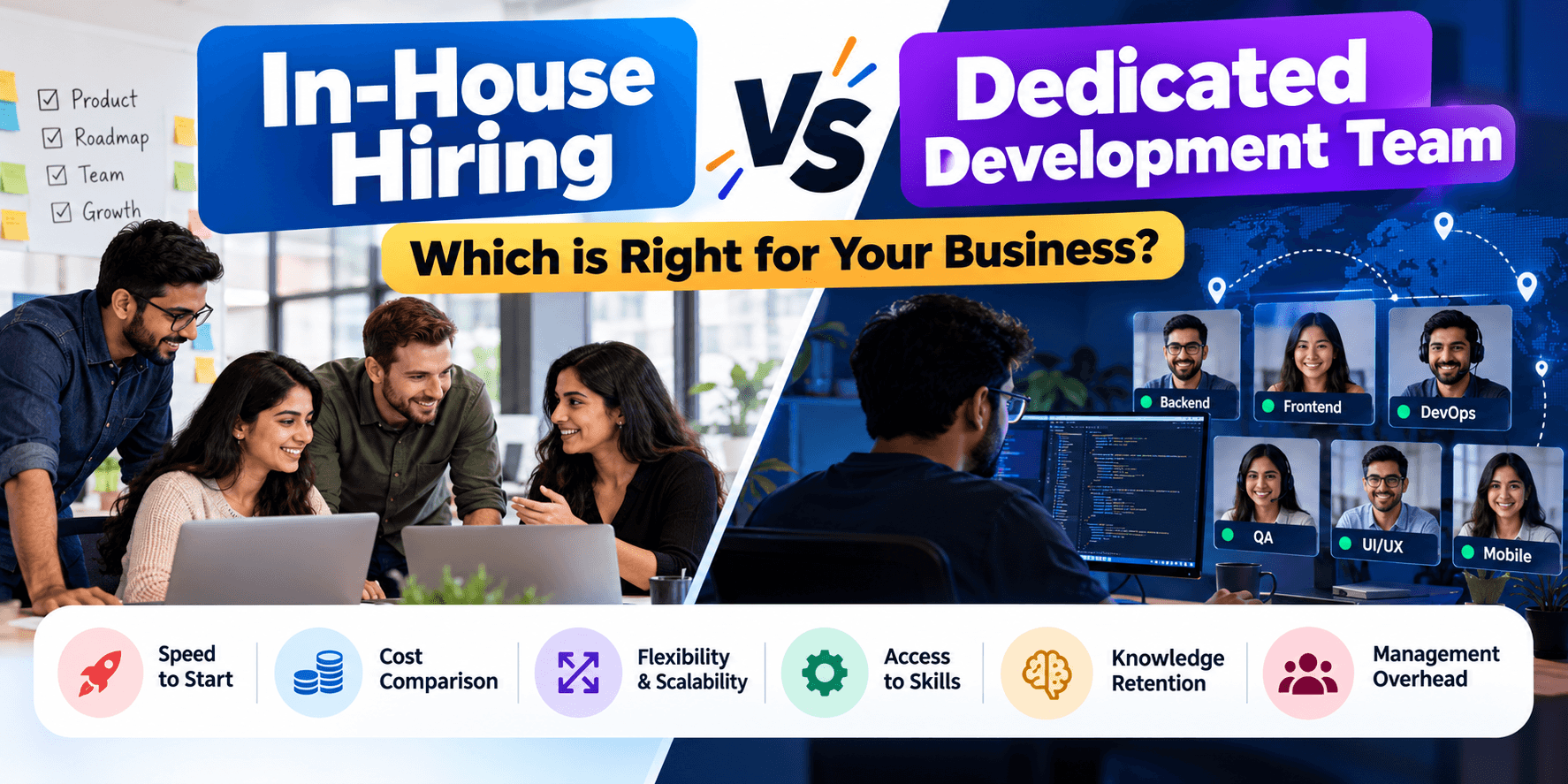
Dedicated Dev Team vs In-House Hiring
How to decide between building an internal engineering team and partnering with a dedicated one.
Datricle • 1 Oct 2026
Short answer: hire in-house when the work is core to your product, long-term, and needs deep institutional knowledge — and you can afford the time and overhead to recruit and retain. Use a dedicated development team when you need to move fast, scale up or down flexibly, or access skills you do not have yet without committing to permanent headcount. Most growing companies end up with a blend: a small in-house core plus a dedicated team that extends it.
The real decision is not "which is better." Both models build great software. The decision is about speed, flexibility, cost structure, and how much of your attention you want to spend on hiring and management versus on the product itself. This guide breaks down the trade-offs so you can choose deliberately.
What each model actually means
In-house hiring means recruiting full-time employees who work directly for your company. You own the entire relationship: sourcing, interviewing, onboarding, salary and benefits, career growth, and day-to-day management. These engineers accumulate deep knowledge of your product and culture over time.
A dedicated development team is a group of engineers — often with a project manager, designers, and QA — provided by a partner who works exclusively on your product as an extension of your team. You direct their work and they integrate with your processes, but the partner handles recruitment, retention, payroll, equipment, and HR. You scale the team up or down as your needs change.
This is different from fixed-scope project outsourcing, where you hand over a spec and receive a finished deliverable. A dedicated team is ongoing and collaborative: they join your standups, use your tools, and own parts of your roadmap alongside your own staff.
The honest trade-offs
Speed to start
Hiring senior engineers in-house is slow. Between sourcing, interviewing, offers, notice periods, and onboarding, filling a single role often takes months — and a full team far longer. A dedicated team can typically be assembled and productive in a fraction of that time, because the partner already has vetted engineers and a bench to draw from. If your roadmap is waiting on people, speed alone can justify the model.
Flexibility
In-house headcount is sticky by design. Scaling down means layoffs, which are painful, costly, and bad for morale. A dedicated team flexes with your needs: add specialists for a big release, trim back during a quieter quarter, or swap skill sets as your product evolves. For startups with uncertain roadmaps or seasonal demand, this flexibility is often the deciding factor.
Cost structure
Comparing hourly or monthly rates misses the point. The real comparison is total cost of ownership. In-house engineers come with salary plus recruiting fees, benefits, equipment, software, office or remote stipends, training, and the management overhead of keeping them productive and happy. A dedicated team folds most of that into one predictable rate. In-house can be more economical for very long-lived, stable needs; a dedicated team is usually more economical when needs are variable or short-to-medium term, because you avoid the fixed overhead and the cost of idle capacity.
Access to skills
You cannot always hire the exact expertise you need, when you need it, in your location or budget. A dedicated team gives you access to a wider pool — specific frameworks, mobile platforms, AI engineering, DevOps — without committing to a permanent hire for a skill you may only need for one phase. This is especially valuable for emerging areas where in-house talent is scarce and expensive.
Control and knowledge retention
This is where in-house has a genuine edge. Employees stay, accumulate context, and carry your product's history in their heads. With any external team there is a risk of knowledge leaving when people roll off. The mitigation is process, not model: good documentation, shared ownership of the codebase, and overlap between your core staff and the dedicated team keep knowledge in the company rather than in individuals. A serious partner builds for continuity, not dependency.
Management overhead
In-house means you own HR, performance, and retention — a real, ongoing cost of leadership attention. A dedicated team shifts recruitment and retention to the partner, but you still have to integrate and direct the team well. It reduces overhead; it does not eliminate the need for clear priorities and good communication.
When in-house is the right call
- The work is core intellectual property and central to your long-term advantage.
- You need deep, durable domain knowledge that compounds over years.
- Your roadmap is stable and well-funded, so permanent headcount will stay busy.
- You can afford the time to recruit and have the leadership bandwidth to manage and retain a team.
- Culture and in-person collaboration are strategic priorities for you.
When a dedicated team is the right call
- You need to ship faster than your hiring pipeline allows.
- Your needs are variable — you want to scale up for a push and down afterward.
- You need skills you do not have and do not want to hire permanently for.
- You are early or capital-efficient and want to avoid heavy fixed overhead.
- You want to test a direction before committing to permanent headcount around it.
The blended model most companies land on
In practice, the smartest answer is rarely all one or the other. A common and effective setup is a small in-house core — founders, a lead engineer or two, people who hold the product vision and long-term architecture — paired with a dedicated team that provides scale and specialist skills. The core owns direction and critical knowledge; the dedicated team provides velocity and flexibility. This gives you the retention benefits of in-house where they matter most, and the speed and elasticity of a partner everywhere else.
Questions to ask before you decide
- How urgent is the roadmap? If you are blocked on people, speed may outweigh everything else.
- How certain is the work? Stable, long-term work favors in-house; variable work favors a dedicated team.
- What is the true cost? Compare total cost of ownership, not headline rates.
- How will knowledge stay in the company? Insist on documentation and shared ownership regardless of model.
- Do you have management capacity? Both models need direction, but in-house needs far more of it.
How Datricle can help
At Datricle, we provide dedicated development teams that work as an extension of your team — engineers, and where you need them designers and QA, who join your standups, use your tools, and take ownership of parts of your roadmap. We help you scale quickly without the overhead of recruiting and retaining permanent staff, flex the team as your needs change, and bring in specialist skills like AI engineering, mobile, and DevOps when a phase calls for them. Just as importantly, we build for continuity: clear documentation and shared code ownership so knowledge stays with your company.
If you are weighing in-house hiring against a dedicated team, a short conversation about your roadmap, timeline, and budget is the fastest way to get a clear recommendation — including the honest cases where hiring in-house is the better move.
Work with Datricle
Planning a product or need engineering capacity?
Datricle builds AI-powered software, SaaS platforms and web & mobile apps — and provides dedicated development teams that plug into your roadmap. Book a free consultation and get clear guidance, timelines and a plan.
Explore: our services, case studies and dedicated development teams.