
Build vs Buy: SaaS Tools or Custom Software?
A decision framework for founders and operators choosing between off-the-shelf SaaS and custom-built software.
Datricle • 8 Oct 2026
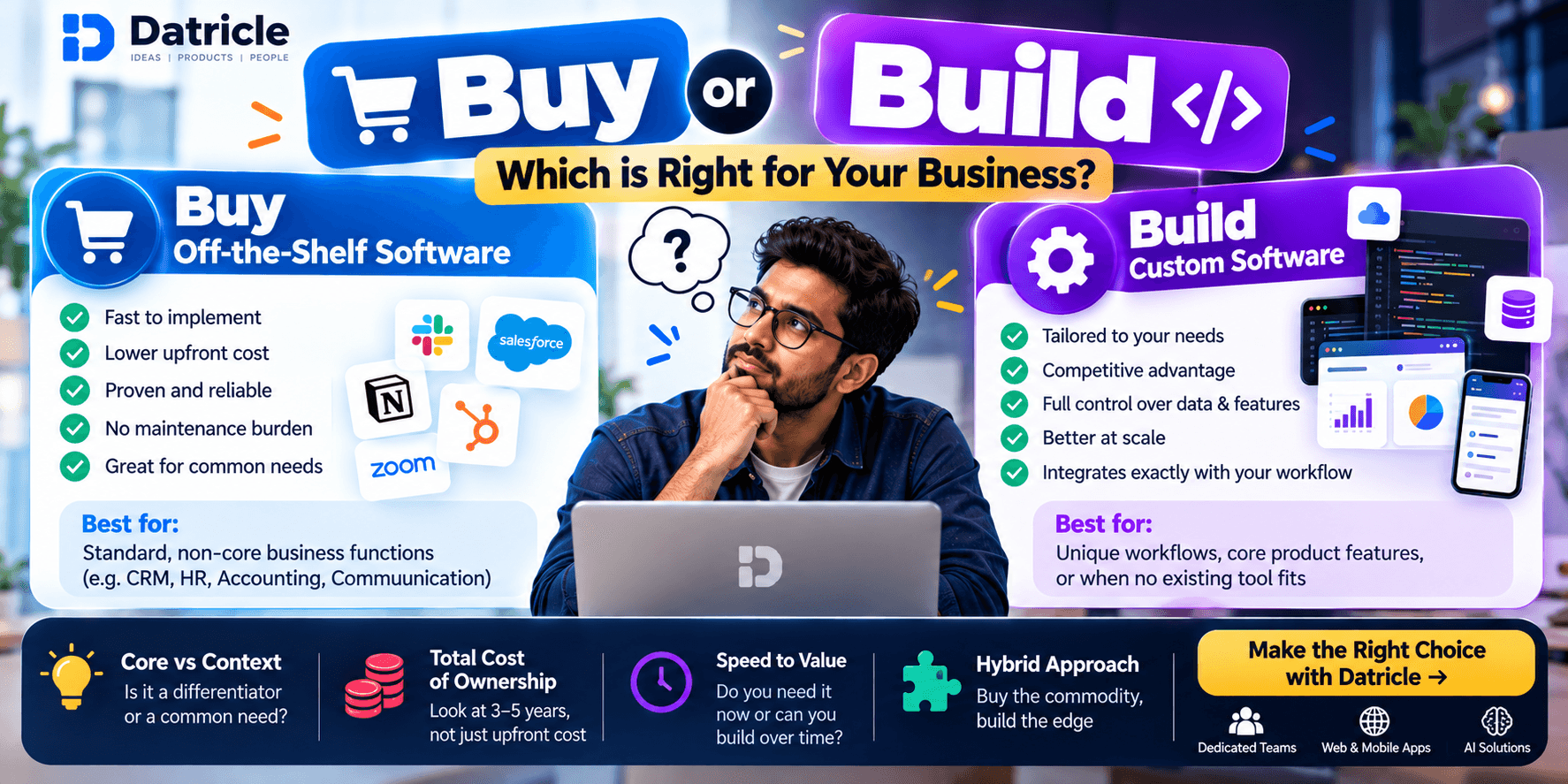
Buy off-the-shelf software when the problem is common and the tool is “good enough”; build custom software when the capability is core to how you compete, when no tool fits your workflow, or when the long-term cost of bending your business around someone else's product outweighs the cost of building your own. Most companies should buy for the commodity parts of their stack—email, payroll, basic CRM—and build only where custom software creates real, durable advantage. The hard part is telling the two apart, and that's what this framework is for.
Below is a practical way to make the build-vs-buy decision without over-engineering it, plus the hidden costs and hybrid options that teams routinely miss.
Start with one question: is this a differentiator?
The single most useful lens is whether the software is core to your business or context. Core capabilities are the things your customers pay you for and that set you apart—your product, your proprietary workflow, the experience only you can deliver. Context is everything necessary but undifferentiated: accounting, HR, scheduling, help-desk ticketing.
The default should be: buy your context, build your core. Spending months building a custom expense tool when a mature SaaS product does it for a modest monthly fee is effort stolen from the thing that actually makes you money. Conversely, forcing your signature workflow into a generic tool because it was faster to buy can quietly cap your growth.
When buying off-the-shelf SaaS wins
Buying is usually the right call when:
- The problem is common and well-solved. Thousands of companies need the same thing, so a mature product already exists and keeps improving.
- You need it now. SaaS is live in days, not months. Speed matters when you're validating a business or filling an urgent gap.
- Your requirements are standard. If an existing tool covers 80–90% of what you need and the gaps are minor, buying almost always wins.
- You don't want to maintain it. The vendor handles hosting, security patches, uptime, and new features. That ongoing burden is real, and offloading it is a feature, not a cost.
- Upfront budget is tight. A subscription spreads cost over time instead of requiring a large build investment before you see any value.
The trade-offs: you adapt to the tool's way of working, you share a roadmap with every other customer, your data lives in someone else's system, and costs can climb as you add seats, usage, or premium tiers. For context work, those trade-offs are usually well worth it.
When building custom software wins
Building is worth it when:
- The capability is your competitive advantage. If the software is the product, or encodes a workflow competitors can't easily copy, owning it outright matters.
- No tool fits. Your process is unusual enough that every off-the-shelf option forces painful compromises or a tangle of workarounds.
- You're stitching together too many tools. When you're paying for five SaaS products and gluing them with manual work and brittle integrations, a purpose-built system can replace the lot and remove the friction.
- Economics flip at scale. Per-seat or usage-based pricing that's cheap at ten users can become punishing at a thousand. At high volume, owning the software can cost less than renting it.
- You need full control. Strict data-residency, compliance, security, or integration requirements sometimes rule out shared SaaS entirely.
The trade-offs here are equally real: higher upfront cost, a longer time to value, and—critically—you own it forever. Custom software needs maintenance, security updates, and a team (or a partner) to evolve it. That's not a reason to avoid building; it's a reason to build deliberately.
The hidden costs people forget
Build-vs-buy decisions go wrong when teams compare a SaaS subscription against a one-time build cost. Neither number tells the whole story. Look at total cost of ownership over three to five years:
- For buying: subscriptions that scale with growth, add-on modules, integration work, data-migration effort, and the switching cost if you ever need to leave.
- For building: the initial build, plus ongoing hosting, maintenance, bug fixes, security, and the cost of adding features over time.
Two softer costs matter just as much. Opportunity cost: every hour your team spends building or babysitting internal tooling is an hour not spent on your core product. And process cost: adopting a SaaS tool often means changing how your team works—sometimes for the better, sometimes not.
The hybrid path most teams actually take
Build vs. buy isn't binary. The pragmatic answer is usually a blend:
- Buy the commodity, build the edge. Use best-in-class SaaS for standard functions and build custom software only for the differentiated core.
- Integrate and extend. Keep the SaaS tools you like and build custom integrations or a thin layer on top that automates the glue work between them.
- Buy now, build later. Use SaaS to move fast and validate, then replace specific pieces with custom software once you understand your real requirements and the economics justify it.
- Configure before you build. Many platforms are far more customizable than they first appear. Exhaust configuration and APIs before committing to a from-scratch build.
A quick decision checklist
- Is this software a core differentiator, or necessary context? (Context → lean buy.)
- Does an existing tool cover at least ~80% of your needs well? (Yes → lean buy.)
- How fast do you need it, and what's your upfront budget?
- What does three-to-five-year total cost look like for each option, including maintenance and scaling?
- Can you configure, integrate, or extend an existing tool instead of building from scratch?
- Do you have the team to own and maintain custom software long-term?
If you can't answer the core-vs-context question clearly, that's a signal to slow down and map the process before committing either way.
How Datricle can help
Deciding what to build is often harder than building it. At Datricle, we help startups and enterprises make and execute build-vs-buy decisions—advising where off-the-shelf SaaS is the smart choice, building custom software and integrations where they create real advantage, and designing hybrid systems that connect the tools you already use. Working as an extension of your team, we can help you scope the core capability worth owning, estimate the true total cost of each path, and build only what moves your business forward.
The bottom line: buy to move fast on commodity problems, build to win on the things that make you different, and treat total cost of ownership—not the sticker price—as the number that decides it.
Work with Datricle
Planning a product or need engineering capacity?
Datricle builds AI-powered software, SaaS platforms and web & mobile apps — and provides dedicated development teams that plug into your roadmap. Book a free consultation and get clear guidance, timelines and a plan.
Explore: our services, case studies and dedicated development teams.